Tuesday, December 31, 2013

New Year, New Goals

One year ends and another begins.  This is a great time for thinking about new goals and resolutions.   It's a good time to think about what you'd like to do with your piano studies.  Obviously, for a resolution to mean anything, YOU have to commit to it and buy into it.  It's great if you choose and follow your own goals.  However, if you're scratching for ideas, here are some suggestions.

1. Commit to 300 days of practice.
Here's how it works.  You don't plan for 300 days.  You plan for 365 days, but you understand that things come up, and you might not be able to practice every day.  Hopefully, those days where you can't practice won't happen often, but you must commit to achieve this.  300 days is 6 days a week for 50 weeks per year.  To prove you've done this:  keep a log of your practice.  Here's an example of how your log may look.

2.  Add 5 more minutes to your average practice time than you did in 2013.
I hate even suggesting practice times because of differing goals and schedules.  Any time you add, even 5 minutes per day, will make a difference.  But if you really, truly want to make leaps and bounds on the piano, you need to be thinking much more than that.  However, let me offer the next suggestion to go along with this one.

3.  Shoot for at least 3 hours of practice within a week.
If you're keeping track of the numbers, that's 6 days of practice at 30 minutes per day.  Now, maybe you've had a busy day and can only practice 10 minutes.  That means you'll have 20 minutes to make up later on.  A good solution is to plan for, as an example, 45 minutes of practice, which gives you some leeway.  No matter how many minutes you practice, the days matter the most!  4 days X 45 minutes equals 3 hours, but it's not as effective in the long run as 6 days X 30 minutes.  Keep in mind that this suggestion is only intended for those who are not already doing 30 minutes per day on the average.  If you're doing more already, then just see if you apply goals 1 and 2.  30 minutes is a floor, not an ultimate goal.  More practice, provided you're practicing daily and correctly, is always better.

Does your practice schedule match the type of pianist you want to be?

4.  Become an expert at practicing, note reading, and technique.
       A. Practicing - Learn how to aggressively and strategically break a piece down and to overcome any difficulties.  Learn how to estimate the maximum number of measures you should expect to learn in a practice session, and become really good at those, not just barely improved over the whole piece.

      B. Note reading - You need to know all the notes you ever see in a piece of music, AND you need to be able to name the notes without having to think about it.  You should be able to see a note and name it instantly.  If you can't yet do this, go here several days per week at http://www.musictheory.net/exercises/note, click the customize button in the upper right corner to set up your exercise to suit you, and get good on the notes.  Answer 100 notes correctly within 3 minutes, and you are an expert.

     C.  Technique -  Play your scales with the right notes and the right fingerings on every single attempt no matter what the speed.  Learn all your chords and arpeggios for your level.  These are the things you just plug into practice and speed up the process.

What else musically do you wish to accomplish next year?

I want to wish all my students and readers a happy New year, and for a most successful 2014!

Thursday, November 21, 2013

Mid Boot Camp thoughts, Facebook Page recommendation

Mid boot camp thoughts
I'm not quite done with the Musicianship Boot Camp testing, but everyone is doing very well on the average.  Two areas that are coming out consistently as things to improve are technical skills and music reading speed.  I'll cover technical skills recommendations in a future post, but let me elaborate on music reading speed.

Since musictheory.net has yet again made revisions to its website, I need to revise my tutorial for the Note Identification exercise.  It's an exercise everyone can use.  If you've mastered your notes, you can stretch your upper and lower ranges, increase your speed as much as possible and incorporate the key signatures you've learned.  Really, everyone should play around with the settings to learn and practice this exercise frequently.

However, remember that the primary purpose is not just accuracy, but speed AND accuracy.  The goal for you needs to be to acquire instant recognition of notes on the staff.  Why?  It is because you don't have the luxury to take your time IF you want to sightread well and spend less time in practice.  So here are a few rules when working with the Note Identification exercise.

1. Challenge yourself, but don't overwhelm yourself.  If you're struggling with all notes, focus on just 5 or 6 to get started.   Exhaust those and then add on to them, or switch to a new group of notes before you add them all together.  It should never feel too easy, but should never be so difficult that you aren't improving quickly.

2. Ignore the percentage.  If you get 10 correct in 20 attempts, it will tell you that you are getting 50%.   If you're working for speed, this or worse may occur, especially early on.  Don't worry about wrong attempts.  If you're following rule 1, you're going to see the same notes over and over and over.  You'll not be able to help but eventually get them right more often than not.

3.  Focus on the number correct AND the timer.  There is a timer that keeps track of your game.  Play the exercise in one of the following two ways.

(A) Time yourself and see how quickly you can correctly name 100 notes.  Don't be discouraged if you're really high the first few attempts, even above 10 minutes.  Your ultimate goal, regardless of level, is to be able to do it in 3 minutes or less.  You can do this if all you have to do is see the note, recognize it right away, point the mouse to the correct letter and click.  Answer 100 correct notes in 3 minutes or less, and you're nailing it.

(B) Only recommended if Goal A seems overwhelming for where you are with learning your notes, this would be to watch the timer and observe when you hit the 5 minute mark of the exercise.  See how many you can correctly name by that point.  Keep doing this until you get at least 75 in 5 minutes. Then go with goal A and see how quickly you can answer 100.

As always, remember the first part of rule 1 and that is to challenge yourself.  If it's getting too easy, how can you make it a little harder?  Add more notes, mix your clefs, add sharps and flats in the key signatures (if you've learned them in your lessons already).  Note reading isn't an infinite skill.  You can reach a ceiling in how well you can do, but that ceiling is very high.  Keep stepping up until you reach it.

Facebook Page Recommendations
If you have a Facebook account, please take a moment if you haven't already and "like" the page for:
The Winston-Salem Piano Teachers' Association (a group I belong to and a page I admin.)
And
My own personal page for my composing and performing at David M Lane - Composer, Musician.  Thanks for your support.

Wednesday, October 9, 2013

Deliberate Practice - A Music and Basketball Parallel

One of my favorite websites to browse is www.lifehacker.com.  Today, they had this wonderful article here about deliberate practice.  It mentions Mozart, but focuses much on basketball player Kobe Bryant.  Parents and other guardians have frequently complained about lack of progress from their child even though they are "practicing".  What's likely going on is that they're sitting down at their instrument, but are they really doing proactive deliberate practice with a goal in mind?  This article explains very well.  I encourage everyone to read it.
http://lifehacker.com/what-mozart-and-kobe-bryant-can-teach-us-about-delibera-1442488267

Friday, September 20, 2013

Musicianship Boot Camp

Introducing something new for my piano students - This is something we are going to try for the month of October and the first part of November.

For lack of a better name, I'm calling it Musicianship Boot Camp.

What is this?  This will be an alteration to your usual practice schedule for the upcoming month.  I'll be asking you to work on technique, music reading, rhythm skills and ear training.   We will work on these things in October.  During the first part of November, we will take portions of one or two lessons to test these skills.  Please note:  I will be giving you a letter grade for how you do.  Don't worry; Unlike school, the letter has no effect on anything you do outside of private lessons.  The grade is just to let you know where you are versus where you should be.

What is the purpose of this?  The four categories we are working on are tools for any musician to have on them.  If a musician knows their technique well, can read notes well, can use their ear and can figure out rhythms, then they are in a great position to learn music faster and learn it correctly.  NOT knowing these things is a hindrance.  Try reading a book written in a foreign language that you don't know.  This is how music is if you neglect your tools.  I like the word "tools" because it suits the context.  Think of cutting a tree limb with a dull saw.  Imagine driving a nail in the wall without a hammer, or drawing with your pencil that has never been sharpened.  There are things in piano that you should know and know well.  You should never have to figure out certain things when you're learning a piece.  You are wasting practice time if you don't have these tools ready.

What kinds of things will you be doing?

Keep in mind that this will be individualized.  I will be assigning things for each of you to do personally that is designed to fit only what you've studied thus far.  I may, in some cases, push you to learn new things or take the things you know and make them better or faster.

TECHNIQUE:  For piano, this involves scales, arpeggios, and chords.  Beginning students may be limited to 5-finger positions.  Some of you will be doing more keys than others.  Some hands separately, while others are hands together.  Some one octave, while others have multiple octaves.  Some will have tempo requirements, while others will not.  You will not be asked to do more than you should already be able to do unless you are already at that level and desire an extra challenge.

RHYTHM:  I will be giving you rhythm exercises that include any rhythm notes you have learned along with any time signatures you have learned.  We will learn how to figure out the rhythm for any pattern using these.

EAR TRAINING:  Every student will be tested on recognizing notes as going up vs going down.  You will be asked to recognize rhythms.  According to your level, you may be asked to recognize intervals, chords, and scales by their sound.

MUSIC READING:  This includes three parts:
1.  Staff Note Recognition:  For whatever notes you have been introduced to so far, you will be asked to get better at note reading.  I will give you a list of notes to learn.  Important to know: Music Reading tests will be timed.

2.  Key Signature recognition and application -  For several of you, this will not apply.  For those who have started adding sharps and flats at the beginning of pieces, you will be expected to name the key of a piece by sight and to play something easy that includes the sharped or flatted notes.

3.  Sight Reading - We'll be working on playing music you've never seen before and improving how well you can play for the first time.

Next week, I'll begin talking to you about your individual requirements.  If this goes well, it will become something we'll do once or twice a year.  The goal is to make much better musicians of all of you by this time in six weeks.

Monday, September 2, 2013

Used Piano Shopping - What to Look For

Readers, I apologize for my extended time off from this blog.  Like many of you, I was in summer mode, but intend to have something for you at least once a week from this point.

A student of mine just inquired about what to look for when shopping for a used piano, so let's go over some important points.

Rule # 1 -  The condition of the cabinet is unimportant.

FACT:  Most people selling their pianos are selling them because they don't play them.  They liked the idea of having a piano in the house, and chose it primarily as a furniture piece.  This means they have probably kept up the appearance - making a pretty, shiny cabinet, but probably not maintained it as an instrument.  Your piano does not need to be pretty to be a good piano.  It can be devoid of polish.  It can have scratch marks.  It's cheap to buy an ugly piano, and then be creative with table runners and to add some polish.  Pianos are like the people you meet;  It's not what is on the outside that counts, it's what is on the inside!

Rule # 2 -  Check the tuning pins first.  If they are rusty, walk away.  Below is a typical, view of the tuning pins inside a piano.  These are not pristine, just dusty.  This is normal and means, however the keyboard sounds, it is at least salvageable.

On the other hand, if the pins look like this, you should not waste any more time.
The price of restoring the tuning pins just so a piano will hold its intonation, not to mention all the piano tunings it will take will in all likelihood EXCEED the asking price of the piano.

3.  Evaluate how badly out of tune your piano is.  If all you're ever going to do is play the piano with yourself (and no other instruments), then it doesn't matter if the D sounds like a D-flat, as long as all the other keys sound just as flat.  In other words, the piano should be in tune with itself.  If having the correct pitch is important to you, then you should buy a chromatic tuner with a sound generator so you can compare a pitch, or download a tone generator app for your smartphone.

Here are some tone generator app choices for Android and for Apple Products.

If a piano is more than slightly out of tune, it could take 3 or 4 tunings to bring it up to standard where it will hold.  This is an average of $75-100 per service in this area at this time.  Remember, it's one thing if a note is a little off.  It's another more serious issue if one, and especially several keys sound like more than one note.  This means the 2-3 strings per key are not in tune with each other.  This is serious neglect.  Below is a video (not available on email versions of this blog), for you to hear a short sample of a piano evaluation.

4.  Check your damper and una corda pedals.  If the piano has two pedals, these are the two.  If it has three pedals, the damper is the one on the right, and the una corda is on the left.  A middle pedal is sometimes cosmetic and doesn't work correctly on an upright anyway.  If you are shopping for a grand piano, it is a consideration.  The middle pedal (the sostenuto) on a grand works like this.  With the lid open where you can see the dampers (see picture below), you play a low note within the first two octaves, THEN press the middle pedal and let go of the key.  Only that damper should remain up.  The others should be down.
Again, this doesn't matter, nor does it work the same way on an upright.  The damper pedal should work and you'll probably know by your ear.  If the sounds sustain while you press the damper pedal, it works.  If the sound stops, it doesn't.  But the above picture shows the dampers, and they should all be off the strings when the damper pedal is depressed.

The una corda acts in the following way.  On an upright, the hammers move closer to the strings.  On a grand, the hammers move a small amount to the right.  You'll actually see the keyboard move on a grand.

If the damper pedal does not work, don't panic.  Open the bottom panel.  You'll either have a dowel rod that is out of place or needs tightening or, in the case of the video below, a pedal linkage rod you can tighten.  The embedding feature is disabled on this video, so you can find it by clicking here.

5.  When in doubt, consult a professional.  Actually, that isn't me.  For piano students on my roster, I will make an effort to see a piano if it is local and give you my opinion as an experienced pianist, but I'm not trained in tuning or restoration.  I would call a local piano technician if the investment is more than a few hundred dollars.  The hundred dollars they might charge is worthwhile.

Wednesday, June 26, 2013

July Lessons, Proof of Practice

For all my students, there will be no lessons from Friday, July 12 through Thursday, July 18.  These missing lessons will count as vacation dates (click here and see third bullet point) that I will not be making up except for a few cases where you are also missing dates in July, in which case we'll try to reschedule one of them.

How can you tell if I've practiced?

Truthfully, no teacher can tell if you've attempted to practice.  However, a competent teacher can tell when you have practiced well, practiced correctly and practiced enough.  When it's obvious you haven't done this, it means one of the following things:
  • You practiced well, but didn't practice enough.
  • You spent time on the piece, but didn't practice correctly.
  • You didn't practice.
What are the symptoms of not practicing or bad practice?

1.  The biggest and most common symptom is that you are not showing familiarity with the piece.  The goal of practice should be to get off the sight-reading stage.  I don't mean literal sight-reading, where you are playing a piece for the very first time with no previous practice.   I mean the stage of learning where you're having to look at every single note, decide what to play, and then play it.  Knowing a piece is going to remove hesitations.  Knowing a piece is going to put you in a partially memorized state where you only need the music as reminders here and there.  If you're having to stop, think about what to play, then play it...then you haven't practiced correctly and/or you haven't practiced enough.

2.  You play with some degree of confidence, but are missing many notes/rhythms/other details.  This is a case of preparing something correctly, and probably practicing enough, but not being careful in the early part of practice when you need to be sure what you're playing is correct.

3.  You play well, but everything is way under tempo.  You didn't practice enough.

If those are symptoms, what are causes of bad practice?  How do I fix this?

First, look at this graph below.  It can show the progress of an entire piece from first reading to mastery.  It can even apply to a small section...even a single measure.
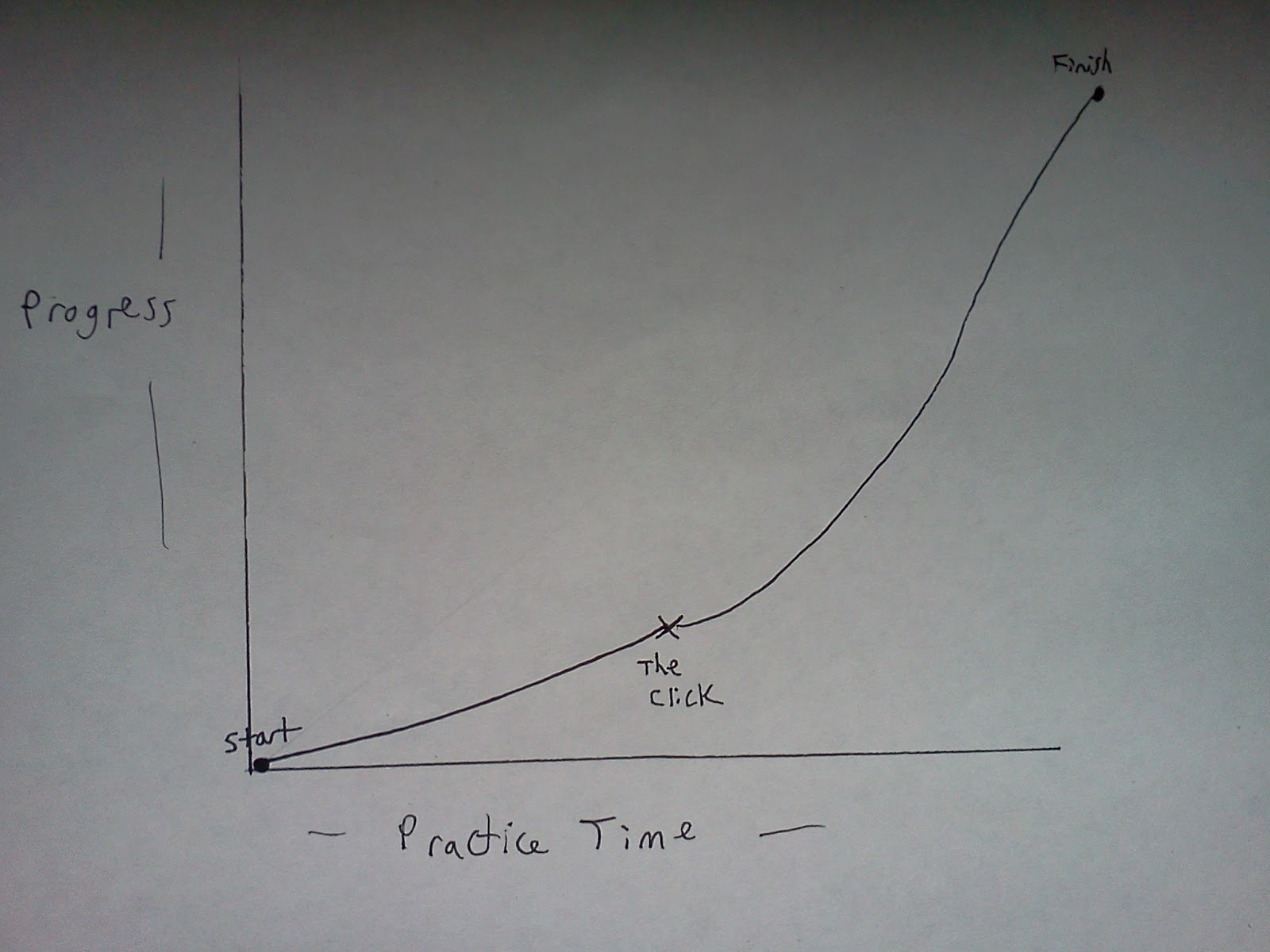
There's only one problem with it.  That straight line from start to finish is COMPLETELY WRONG.  If you go into your practice with expectation of smooth and steady progress, you are only going to achieve that if the new music is way too easy for you.  In other words, smooth and steady progress is actually an indication that you're playing the wrong music!

Here's the way correct practice actually looks:
Look what happens.  Nearly halfway through the time you expect to practice, you are barely making progress.  It looks hopeless.  It feels tedious.  Why?  It's because you are going v-e-r-y s-l-o-w.  You are being careful, making sure that every note and rhythm is learned correctly; making sure that at some point you can maintain a slow and steady beat; making sure that you have added correct pedaling, dynamics, articulation and whatever details the music asks for.  It's slow, but it's correct.

At some point, it finally feels good.  It feels easy.  I call this "The Click".  Look what happens after the click.  You take off!  Practice gets fun!  What you are now doing is taking the newly learned music and allowing it to feel easy and, if necessary, get faster.

To practice well, remember these 3 tips:
(1)  Don't mistake "The Click" for being the finish line.  Feeling comfortable with something is a beginning.  Ride it through to the end when you really, truly, thoroughly know it.  That's when music gets fun.  I know this has happened when a student can only play their pieces with careful thought and a very slow tempo.

(2) Don't rush to the 2nd half, beyond the click.  If going slow is difficult, going faster makes it worse - always!  Don't dive ahead into repeating music over and over without first making sure at a very slow tempo that it is completely correct.  I know this happens if the piece is confidently played, but with frequent mistakes.

(3) As a rule, work 2 to 4 measures at most with the above graph.  It takes 5 to 10 minutes if you're on the correct level (and if your note reading is par for your playing) to go from mystery to mastery in that time.  Trying a whole piece or even a large section will take a long, discouraging amount of time.

Always remember what correct practice looks like and what it doesn't.

Friday, June 7, 2013

Kissin Plays Beethoven, Changes to Musictheory.net

To be a great pianist, watch great pianists.  Obviously there's a LOT more to it than that, but you can no more skip this step than you can be an NBA basketball star without watching the players already there. This is the great Evgeny Kissen performing Beethoven's Rondo e Capriccio (also known as the very strangely nicknamed "Rage Over a Lost Penny")  Please note: if you are reading this blog page as an email subscriber, you will need to follow the link to the actual blog post to see it.


Changes to Musictheory.net

In an earlier blog post, I gave an introduction and tutorial to using musictheory.net, focusing on the note identification exercise.  The video shows how to set up the exercise so that it suits you.  The website has since changed their format.  If you go to www.musictheory.net, click on the Exercises tab, you no longer want to just click on the exercise.  Instead of going to the setting page first, it will now begin the exercise WITHOUT YOUR CUSTOMIZATION.   Before you play the game, you need to scroll down the page until you see FOR TEACHERS, and click on Exercise Customizer.

From this point, you can set up the exercise(s) exactly as I demonstrated earlier on this blog.