Showing posts with label practice tips. Show all posts

Monday, April 27, 2020

How to Improve Your Sight-Reading (Sight-Reading Part 2)

Okay, I didn't think the follow-up to the first part of this series would be nearly 5 months later, but there are a lot of things for 2020 that I don't think anyone expected!  Anyway, better late than never.

There are 2 points I made in the previous blog about sight-reading.
  1. You can aspire to be a pianist-for-hire without becoming a true virtuoso.
  2. Of all the things you need to improve to do well as a pianist-for-hire, there is nothing more important than sight-reading.
But how do you improve your sight-reading?

There are many approaches and techniques, enough so that I won't cover them here, but I'll give you some broad suggestions.

Learn your technique in your hands and on the staff.
So much of music is scales, chords, and arpeggios.  Part of sight-reading well is to be able to not only recognize what you see, but actually be able to play it when you do.  Again, there are two components.  What does the technique look like within sheet music?  And how do you play it?

Piano students more often than not underestimate the importance of technique and also the standards of good technique.  For example, take the C major scale.  Can you play it 1-octave hands separately? How about hands together?  How about 2 octaves separately and together? 4 octaves? Contrary motion? In 3rds? In 6ths? How fast can you play each one?  And that's just one scale.

Treat your technique with this recipe:
  1. Master a specific technique (i.e. 1-octave scale hands together) slowly with 100% correct fingering and 100% correct notes.
  2. Speed up until it's really fast.
  3. Make the technique harder (i.e. 2 octave scales)
  4. Repeat steps 1 through 3 over and over.
This can be a parallel development to everything else.  You don't have to be in full mastery of every technique to be a good sight-reader, but the limit of your technique will limit the difficulty of what you can play in one attempt.

Improve your recognition of rhythms, notes, intervals, and chords
As I'm telling my students all the time, it's not enough to be able to look at a note on the staff, give it some thought, and then name the right note.  Each note has to be INSTANTANEOUS in its recognition.  But the truth is, while that's an ingredient to good sight-reading, it's only one of many.  Much like reading this blog requires first knowing your alphabet, then recognizing words, the definitions of the words, the structure of a sentence, and groups of words creating a thought... your note recognition has to be combined with other elements.


  • Rhythm: There are books just for rhythm that are progressive.  I would find one with a CD or online demonstration/play-along and then ALWAYS try it without listening first, then listen to check how you did, then play again.
  • Notes: The best way I know to learn is online games that involve beating the clock, such as musictheory.net/exercises/note.  How many notes can you get right in a minute?  Any slower than 30 per minute, and you're taking too long to think about it.  See my recent blog post that gives a note-tutorial for musictheory.net
  • Intervals: Recognition of 2nds, 3rds, 4ths, 5ths, etc is only helpful if you can do it without naming any of the notes.  If I point to two notes on the staff and ask you to name the interval, and your response is to play the notes on the piano (example: C up to an F), and then say "a 4th!", you are not independently recognizing your intervals.  Go to https://www.musictheory.net/exercises/interval.  This is a great exercise because of the ability to increase the level of difficulty.  
    Let me know how you do with the Accidentals of doom!
If you are beginner, not only start with Level 1, but uncheck all of the intervals except the ones on this column.  Then gradually add the rest of them.
Here is final setting.  On the play mode, leave the setting at Harmonic, but at some point try Both.  Finally, your game is ready, and looks like this.  

  • Chords: Chords are your more advanced vocabulary words.  You want to learn root position chords, then inversions, then 7th chords and their inversions, then the more extended chords (especially if you're playing jazz, funk, or blues).  I won't clutter this section with more screenshots, but the setup for https://www.musictheory.net/exercises/chord is very similar to that of the intervals, with 5 letters and everything.  There is an Inversions button you can check on and off.
Raise your level of playing through experience
This is not a theory I can cite from other sources, but entirely my own observation.  Your level of ability on any instrument is defined by the average level of all the music you've practiced.  If you spend a lot of time on easy pieces that you can learn in a few days at most, then you're not pushing yourself.  It's the brain-busters, the pieces that make you question yourself, the ones you have to take 1 and 2 measures at a time over and over really slowly that make you truly grow!  You need to always have a project going that stretches you.

Get experience with sight-reading
If you decide to run a 5k race, you can go online and read all about strategy and correct form, and basically everything you need to know to run your best 5k time.  However, none of it matters unless you actually practice running.  The experience is where you improve, not the knowledge of it.  All of the things mentioned here are tools.  They equip you to do a good job, but you need to practice sight-reading and log in many, many hours of doing this very thing before you actually get good at sight-reading.

First, you need some materials.  By that, I mean that you need music just for sight-reading.  Ideally, it needs to be music that is comfortably but not excessively easier than your average playing level (see previous section on this blog).  It's not to say that you couldn't go with something only moderately easier than your average that you would continue to practice and work up, but to know if you're improving your sight-reading, the goal is this:  Find the hardest level of music (no matter how easy that is) that you can play on the first attempt with at least 80% accuracy.  The goal is then to increase the difficulty level of the music you can play this well on the first attempt.

OPTIONS FOR COLLECTING SIGHT-READING MATERIALS:  (1) You can always go to where sheet music is sold, and get method books for brands other than yours.  Most of my students are on Faber's Piano Adventures.  If you're not, then try that brand for sight-reading.  Other common choices include Bastien, Alfred's, Hal Leonard, and The Music Tree.   There are also books designed for Sight Reading (and includes this term in the title) where the exercises start very easy and get progressively more difficult as you go. (2) Shop used-book stores in the music section, or check Goodwill or other thrift stores.  Many piano students don't often hold onto their student books after a while, and this is a good place to find easier music that you haven't previously practiced.  (3) Seek out friends or family members who have taken lessons and see if you can at least borrow some of their music books.

The point is...practice for the sake of improving this skill many times a week.  Grab something you've never played, and just play without stopping.  Keep your eyes moving ahead, don't stop for mistakes, and see how you do.  Very important: Before putting the music away, look at where you had any real trouble playing it well, and evaluate why it was hard.  Did it involve notes, intervals, or chords that you found difficult to recognize quickly?  Did you take your eyes off the page?  Did you end up staring at the notes you were playing rather than looking ahead?  Did the place in question involve technique (such as a scale) that you need to improve?

The under-rated skill-builder: playing from a hymnal!
Beginning students should probably ignore this section for now, but this is a great tip for intermediate students.  This is also GREAT for jazz pianists.  Buy a hymnal with traditional homophonic hymns.  Homophonic means that the music looks mostly like this, where you have 4-notes per chord (most chords) and that each note is moving at the same rhythm (as opposed to polyphonic hymns where the soprano and alto might have different rhythms).
One thing you'll notice about this that takes some getting used to is that, because hymns are written to be sung by a group of voices rather than to be played, you have to compensate that the tenor voice (top bass clef note) is often far apart from the bass voice (bottom bass clef note), often beyond the reach of your hand.  Look at the last measure on the first line.  The last note is an octave, but the two notes before that are difficult-to-unplayable stretches for the LH.  However, in both cases, it is an easy reach to add the tenor notes to the bottom of the RH so that you are playing 3 right-hand notes vs 1 left-hand note.  You'll also notice in places like the 5th note of the 2nd line that the tenor (top bass clef) and alto (bottom treble clef) notes are the same.  Therefore, when you play it, you play the single note with one hand and ignore the other.  These are the types of things that make playing hymns sneakily difficult.  Nevertheless, they are invaluable and highly worth including in heavy doses of sight-reading for a few reasons.

First, in spite of the difficulty of learning how to play a hymn (singular), it doesn't take a lot of practice before it gets to be fairly easy to play hymns (plural).  This is because there isn't much difference between the easiest and hardest hymns to play out of one hymnal.  A few hours of practice and you'll lock in to HOW to play a hymn on the first attempt.

Second, (and jazz players, play attention!!), it is an unequaled way to gain experience in great-sounding chord voicings!!  To refresh, chords are how notes are grouped together (CEG is a C major chord), but chord voicings are how they are organized between the hands (C-G in the LH, E-C in the RH) and how one chord moves to the other in a smooth way.  Smooth voice leading in chords sounds great on any instrument, but it's actually imperative for groups of vocalists singing in harmony.  Your inner voices (altos and tenors) would have a hard time for amateurs to sing their part if it was jumping all over the place, so they tend to have a lot of repeated notes and steps with only a few skips.  Well, those same voice leadings are absolutely wonderful to use as reference when playing from a lead sheet.  It doesn't take much practice to figure out how to convert them as 7th and 9th chords.  And if you're not wanting to learn jazz from a lead-sheet, the voicings used in hymn harmonies are so often used in classical piano voicings for similar texture.  Being proficient in hymn reading will have instant benefit on reading traditional piano music!

Finally, playing hymns gives you the ultimate practice in moving 4 parts of music at once.  You cannot play hymns well if you are trying to move the top line, then the middle lines, then the bottom line chord-by-chord.  You need to learn how to put your interval and note skills in combination and see how each chord moves as an entire group, NOT just one note at a time.

I haven't yet exhausted sight-reading as a subject, so I will probably revisit this some day, but I hope all of you who aren't absolute beginners will make sight-reading a regular priority in your practice!

Wednesday, May 22, 2019

What's keeping you from being a GREAT pianist?

For the sake of simplification, we're going to say that there are 4 types of pianists in the world: Bad, Average, Good, and Great.  I understand that there are transitionary levels ("below average", "above average"), which do not need to be mentioned since these imply moving from bad to average or from average to good.  I also won't mention descriptions beyond great (such as elite) which represents a very small percentage of people who play piano, and honestly... If you're old enough to read this blog, and are reading about about how to improve your pianism, then you probably haven't started early and fast enough to become elite.  But don't be depressed.  Being merely a great pianist is not only nothing to cry about, but it is a laudable achievement that is something to strive for.

However, most pianists are not great.   Bad and average pianists probably make up way over half, maybe even 60% of all pianists in the world.  Of the remaining 40-50%, most of these pianists are good, with only a small percentage being great or elite.  Why is this the case?  For reasons you'll see, climbing up the ladder in pianist categories is hard.  This is very important before we go on.  It's crucial that you accept this fact before moving on with this article, because I'm going to make a big deal of it.

Being GREAT at piano is HARD!

Being GREAT at piano is HARD and takes A LOT of time!

Some of you might be thinking: Really? Okay.  I guess I won't be a great pianist if it's going to be really hard and take a lot of time.  I'll go be great at something else that isn't as hard.  So, let me go ahead and tell you this before you go away.

Being GREAT at ANYTHING is HARD and takes A LOT of time!

So if anything requires difficulty and time to be great, why not pursue that on the piano?  Let's proceed.

This article is about becoming GREAT, but we have to quickly talk about how to get from bad to good.

TO BE A BAD PIANIST
Simply play during your lessons, and hardly ever in between.  Practice, if it occurs, is unfocused.  Or...take a few lessons, and stop.  Don't practice at all.

TO BE AN AVERAGE PIANIST
Practice at least a few days per week with some focus.  Practice on new and challenging material doesn't have to be a high percentage of your piano time, but it needs to be something regular.  Do this consistently for at least a year or two, and you will be an average pianist.

TO BE A GOOD PIANIST
Practice needs to become a HABIT.  You need to shoot for daily time at the piano.  You need to be focusing practice on new and challenging skills and pieces.  You also need to be taking lessons, or have someone experienced who can give you feedback.  How much time should you be spending?  Honestly, it doesn't really matter.  Practice 15 minutes a day with focus, and you'll eventually be good, but it may take many years.  Practice several hours a day, and you'll get good faster.  But practice 8 hours a day with just what I said, and you'll never be great.  Sorry, but it's not enough, and that's because time and effort are only parts of what make someone great.

What's keeping you from being a GREAT pianist?

1. You're not GOOD yet.
This is a simple test.  Is practice a habit, a daily habit?  Are you focusing on new and challenging material?  Are you taking lessons, and applying feedback to your practice?  You have to do this to become good.  You don't go from bad to great or average to great without passing by "good".  Check your habits.  This is not requirement 101, but 099...something you must do before you can move on.

2. You place too much value on comfort and satisfaction.
As I said, practice 8 hours a day with the habits of a good pianist, and you won't be great...IF your material and technique doesn't stretch you to your limits.  A runner who isn't huffing and gasping every now and then knows they won't get faster.  A weight lifter who doesn't feel the soreness of muscle burn isn't getting much stronger.  As a musician, you must face the facts: Stretching yourself requires DISCOMFORTPracticing in a way to be great will not feed your ego.   If you want to be a good pianist with great self-esteem, then take that piece you learned last year that you already know and play it until it's fast and fulfilling.  Being a great pianist will not feed your ego.  The road to being great is chock-full of potholes.  It is constantly under construction.  There are detours.  You'll have times where you wish you could just go back to the land of good and stay there.  At the same time, the road to great does make progress, and you are getting closer if you persevere.  The next few points are related.

3. You waste time on easy sections, and ignore what is difficult.
Unless you're trying to jump many levels ahead, almost nothing you practice is totally hard.  It has easy measures and hard measures.  In most cases, it should be simple to figure out which is which.  The ego-driven good pianist practices what is easy every chance they can, because it's fun to hear the accomplishment and avoid the brain strain of what great pianists do:  Dive in, struggle, and wrestle with the difficult sections.  Commit a large portion of your practice to the hard places.  Tackle them first, and tackle them often.  If you have pesky measures, there's a huge advantage to doing 5-10 focused minutes of practice on the same spot multiple times a day.  Give yourself a break, but keep coming back.  Don't get mad or discouraged while it's hard.  You WILL win every match eventually if you simply don't give up.

4. Your music is too easy.
Here's an easy guide to the levels: To be average, play music that average pianists play.  To be good, play music that good pianists play.  To be great, play music that great pianists play.  Now this is tricky, because the road from Clementi's Sonatina op. 36, no. 1 to Beethoven's "Hammerklavier" Sonata (still regarded as one of the most difficult pieces ever written) has many, many steps in between.  Your music should always challenge you, but never overwhelm you.  You need to be practicing music that will advance you a few more miles down the Road to Greatness.   Practice easier music to stay in the land of good, but with more property. This is where a teacher is invaluable, to help you move forward at the pace that best suits you.

5. You ignore or underemphasize your technique.
 If you didn't already, please click on the link in the above section for Valentina Lisitsa performing the finale of the Hammerklavier Sonata.  To achieve the speed and independence required to play that requires many hundred to thousands of hours on specific scales and arpeggios, not to mention etudes and exercise that mix these together.  Here's a fact: The speed of your scales is the limit of how fast you can play music with those scales.  The same goes with arpeggios.  Learn your skills, then speed them up, then learn them in harder ways, and speed them up again.  This needs to be a regular part of your practice.

6. You neglect your theory.
I've met good musicians who don't know much about theory, but I've never met a great musician who was lacking.  Theory requires study, written study.  The more you know, the better you understand what you're playing. 

7. You haven't mastered the art of Deliberate Practice
This is the most important distinction between a great and good pianist.  A good pianist can work on something hard, but the goal might be: I'm going to start on measure 1 and play to measure 16 as many times as I can within 20 minutes.  The great pianist looks at the really tricky measure 12 (the one with the chromatic scale), and practices ONLY that for 15 minutes.  They practice it super slowly focusing on fingerings and absolute accuracy.  Then they apply long-short and short-long rhythms.  They also approach it from the end, moving progressively backwards from the beginning.  They notice that it's kinda chromatic, so they review a chromatic scale.   They then get out a metronome, and work on the tempo.  They'll also do this tomorrow and the next day and so on until it's mastered.

This blog was inspired by a book that talks about this 7th step, one that I highly recommend to those of all ages: "So Good They Can't Ignore You: Why Skills Trump Passion in the Quest for Work You Love" by Cal Newport

By the way, there is nothing wrong with being an average or good pianist.  If you enjoy the fun side of piano, but get burned out from the challenge, this is not something to find shameful or embarrassing.  Music should, in the end, give you joy and serve your needs.  This article is only if you're wondering: what's keeping me from being great?  And the answers are: only your time, your resistance to difficulty, and/or your approach to learning.   Master those steps, and you'll too be great!

Tuesday, November 27, 2018

Why do we practice?


We practice because...

  • it's our only hope for progress.
  • it's our only hope against regression.
  • we don't want to merely like the idea of being a pianist, but we want to be the pianist.
  • there is so much to learn!

  • nobody else will practice for us.
  • somewhere, someone else is not making excuses.  They're getting better and playing the music you want to be playing.

  • we recognize that practice isn't punishment or a chore, but the proven secret to success, the formula that thousands of musicians follow every day!
  • if it were easy, EVERYONE would do it.  It's not always easy, but it's always worth it!
  • we don't think of it as something we have to do.  It's something we get to do!

It's all of the above.

"Practice only on the days you eat." -  sign in a high school band room.


Tuesday, February 6, 2018

The Blog Returns/Learning Difficult Music (10 Steps)

Hello Again

Part of me is tempted to use my absence from this blog as a metaphor for how bad practice habits can become catastrophic.  My previous post was from November 2015, well over 2 years ago.  Did I mean to take a 2-year sabbatical from this blog?  Or did I mean to quit the blog entirely, and just came back early?  No and no.  Right after November, came Christmas.  In January 2016, I was preparing a show.  After that...  Okay, there aren't any real excuses except that it became easier and easier to move this down on the priority scale.  It's easy to say:  I'll just keep what I've already posted active, but there's no hurry on getting any new posts.  Then it becomes a habit not doing new posts.  Then it becomes hard to get around to it.  Practice is like this.  One excuse becomes two excuses, becomes multiple excuses, becomes the habit of not practicing.

Okay, so I did give into that temptation.  I don't have a fixed schedule for this blog, but I still have plenty more to say that doesn't need to be limited to individual lessons.

Learning a Difficult Piece or Passage

I was in the midst of practicing Cesar Franck's Prelude, Fugue et Variation, op. 18 - originally an organ piece that has been transcribed for piano by Harold Bauer - with a "business as usual" approach.  I got to a 11-measure section that was difficult, 5 measures which I found VERY challenging.   I also was working on a piece by Prokofiev that starts sight-readable (see my definition below under step 3), but every 8 measures gets more and more difficult. When this happens, and it WILL, you have to modify your approach, but can still have a very productive practice session with it.

1.  RELAX
This is a lesson that I didn't follow as a child (or even young adult).  Decades of experience have taught me that getting frustrated is never the cause of success and is usually an impediment.  Just relax and take a deep breath.  Also, try this:  Shrug your shoulders and give yourself an amused smile.  Try a chuckle.  Think or say, "Oh well.  Here we go."  This is the first of 2 attitude adjustments.  The second is...

2.  ACCEPT THE CHALLENGE
You can do four things with difficult music.  (1) Don't try it.  Quit.  (2) Practice it with carelessness and/or apathy.  (3) Practice it carefully while dreading it.  or (4) Practice it with calm delight.  Please tell me you've never seriously considered the first two.  I can't help you there, but hopefully I can encourage you to move from the third approach to the fourth.  Accept it!  This music (piece or section) is hard.  You're not going to be able to just plow through this or sightread it.  You're going to have to dissect it, slow it way down, concentrate harder, and struggle...yes struggle.

There's a great quote that is the basis for many memes: "Embrace the struggle. It will make you stronger, and it won't last forever."

This will be hard, but this will be fun.  And in the end, you'll learn this just like everything else, and you will be SO proud that you stuck with it.

3.  CUT YOUR MUSIC IN SMALLER CHUNKS
Here's a good scale that I use.  EASY - means I can just about sightread it up to tempo, or at least 2/3 of performance tempo.  SIGHTREADABLE - At a slow tempo, I can keep playing without much difficulty.  NORMAL DIFFICULTY - Too challenging to sightread well, but I can work for 20 minutes or so within an 8 measure section and make significant progress.  DIFFICULT (what we're talking about) - Need to cut to 4 measures, or maybe 2, or maybe JUST ONE measure at a time.  Review the steps RELAX and ACCEPT THE CHALLENGE, and just go ahead and do this.  Trim your music until it gets to be an appropriate section for the challenge.

3a.  Identify what are truly the most difficult passages within your section and work on those first.  Often, it's a few beats here and there.

4.  ENGAGE THREE SENSES with INTENSE FOCUS
(1) SEE the notes on the staff.  SEE the keys you are playing.  LOOK at your hand-shape and finger alignment.  Are you hitting each note or chord squarely?  (2) LISTEN to the sounds of each correctly played note or chord.  (3) FEEL the shape of your hand.  MEASURE the distance from one jump as you do it repeatedly.  Pay hard attention to each of these.  Don't play them while your brain wanders off somewhere else.  If you want to learn difficult music, you have to give it your FULL ATTENTION.

5.  REPEAT EVERYTHING MANY TIMES.
Get it right once and it's possibly a fluke.  Get it right 5 times, and you're on the right track.  Get it right 10 times, and you probably have it.  Get it right 20 times, and you've probably mastered it.

6.  SLOW TEMPO, NOT SLOW MOVEMENTS
This is crucial.  Slow the beat way, way down.  If it's 1/10 performance tempo, who cares?!  Slow it way down.  However, move from one position to another with deliberation and full speed.  Play the keys full speed and with emphasis and confidence.  Trills, grace notes, arpeggiations, and other ornaments all go at full speed ASAP.

7.  MAKE A TECHNICAL EXERCISE
This can include practicing in varying rhythms.  If it involves broken chords, block them.  If it involves scales or arpeggios, try some that are similar to your passage.

8.  SEPARATE THE HANDS
If two hands are hard, try just one until that gets easy enough.

9.  STOP WHEN YOU NEED TO
If it's truly difficult.  You probably won't master it in one sitting.  Make progress, and know when to move on.  Don't be surprised if the next time you practice feels like you've regressed a little, but you should quickly get back to where you were and be able to surpass it.

10.  PRACTICE DAILY UNTIL MASTERED
Don't get this started (like I did this blog), make some progress and leave it alone.  Leave things alone when you cannot overcome frustration.  If you're making progress, no matter how slowly it's coming, and can stand to face it again.  Keep coming back.  Eventually, you will have it and may soon forget why you found it difficult.

Tuesday, November 3, 2015

The Art of Practice - a Video

A few years ago, the University of North Texas College of Music produced this video on the art of practice.  It is targeted toward vocalists, but it's very applicable to pianists and other musicians as well.  It's worth the 9 minutes to watch.  Don't be put off by the level of intensity that is described in the practice sessions of these aspiring professionals.  However, please notice the passion and the description of what makes for good, true practice.  Any small amount of good practice is better than a whole lot of bad practice.

Tuesday, October 27, 2015

Improve Practice by Being Specific

Recently, I read the 1937 classic book, Think and Grow Rich, by Napoleon Hill.  If you've never read this, its title is deceptive.  It doesn't offer schemes to increase your bank account.  Instead, it talks about cultivated the mind-set that leads to success, which may happen to include but doesn't necessarily limit itself to monetary wealth.

A big part of his philosophy stresses the importance of establishing a DEFINITE GOAL.

Definite Goals come in long-term and short-term.  I won't elaborate further on the book, but I want to talk about you and your music goals.  It is very effective to use definite goals as a pianist.

Long term:  What kind of pianist do you want to be?  Re-read the blog post I wrote to review which type of pianist you should be shooting for.

Short term: (and this was what I wanted to focus on) - what are you going to accomplish in practice this week?

Examples:
INDEFINITE goal:  "I'm going to practice a little bit each day as time permits.  I'll try to go through all my assignments and see what happens."

DEFINITE goal:  "I'm going to double the tempo of my C and G major scales.  I'm going to study my note recognition on musictheory.net and get 100 correct answers in 3 minutes.  I'm going to complete my theory assignment.  I will thoroughly master a 16-measure passage in my repertoire to the point where there is hardly anything else to accomplish."

See the difference?  The indefinite goal gives you no clarity.  There's also no accountability.  You could accomplish nothing at all, and be emotionally okay with it.  In the definite goal, you have a target.

What next after you establish a definite goal?
Now you look at your week, your schedule, your current knowledge of how long it takes you to learn music, and determine how much you need to practice.  After you gain some experience, it's good to work this step in harmony with your weekly goal.  Choose a weekly goal that you can actually meet.  At the same time, challenge yourself to accomplish as much as you can.

If you don't meet your goal...
...then don't fret about it.  Setting goals is a work in progress, and merely a tool.  If you don't accomplish something, look at what you did accomplish and where you fell short in your goals.  Look at WHY you fell short.  Can you improve the way you practice?  Can you spend more time in practice?  Are you focused and in full concentration?  Answer these questions and adjust, if necessary, the ambition of your future goals.

So, what are you going to accomplish in practice this week?

Tuesday, June 2, 2015

5 X 5 approach

I have shared this following approach to practice already in some of your lessons, and I wanted to introduce it to everyone else here.


This concept was inspired by a fitness video I saw.  The guy had a workout called 5 by 5.  He took 5 challenging bodyweight exercises and recommended doing 5 sets of 5 reps.

One thing that always stuck from my own piano education is the rule that if you can do something 5 times correctly, you have learned it.

I would further add that if you can do something 5 times correctly, and continue to do that every day until you've done it for 5 consecutive days, then you REALLY should have it down.

The Five Rules
The rules are really simple.
1.  Whatever you practice, do it 5 times in a row correctly.
2.  Correctly means 100% accuracy.  If you missed one note or one finger, it was not correct.
3.  If you mess up, the count starts over.  Go through what you're practicing 4 times without a mistake and miss a fingering on the 5th attempt?  Sorry, but you have to start all over.
4.  This means that accuracy and precision are by far the most important things.  Speed does not matter at all.  Go absolutely as slow as you need!
5.  Repeat 5 days in a row, and marvel at how much easier it gets each time.  Speed will come without effort.

Ways to incorporate 5 X 5 practice
  • Take any challenging technique (a new scale, chord progression) and practice it as slowly as needed.  Just ensure that every note you play is correct...no matter how slow.  Do it 5 times in a row.  Don't allow it to speed up for the first 2 days.  On days 3 and 4, allow it to gradually speed up each repetition.  Day 5, it should be feeling easy.  Get your 5 times in carefully, then test yourself for speed.
  • Take any particularly difficult part of a piece you're working on, practice the very end of the section 5 times, work back a measure to get into it and do that 5 times.  Keep doing that until you're starting from the beginning of the section.  Again, it must always be correct, and you need to do this 5 days in a row.  It should get easier each day.
  • If you're working on something like reading notes on a staff, you could go to MusicTheory.com's note exercise, change the settings so that you're working on only the notes you're trying to learn, and see how many notes you can correctly identify in a 5 minute session.  Write down your score (number correct).  Do another 5 minute session the next 4 days, and see if the number you can correctly identify goes up.
Use your imagination when applying this.  It works because it demands perfection first, and repetition second.  Be patient early on.  You will undoubtedly mess up and have to start over your count, and it will feel like it's taking forever.  However, you will eventually get good at this type of practice and see it as nothing more than a tool that will reliably make you a better pianist.

Wednesday, May 21, 2014

Residual Effects of Practice

First of all, congratulations to all who participated in the Spring Recital!  Every time you get up in front of people and perform, you should be proud, whether it was the best you ever played or not.

I am in the midst of rehearsing a show as music director and pianist, a show that is known for a difficult piano part.  Now that I've played it with the cast close to a dozen times now, I'm able to make some observations while I'm playing.

1.  At least 90% of this score was sight-readable for me.  Of the 10% I couldn't sight-read well and had to practice, I didn't have to spend more than about an hour of total practice learning 9% of it.  There's about 1% that is genuinely hard and I'm still working on getting comfortable doing.

2.  When I'm playing, I use very little movement.  My wrists and shoulder movement are exactly what I teach in lessons, but I'm not doing much of it, just enough to play it well.

3.  When I play, I know it "looks" easy.  As a matter of fact, it "feels" easy.

All of this led to a conclusion:
The benefits of ease in playing this show are the result of INTENSE PRACTICE of PREVIOUS PIECES.

If you're not struggling with a piece, you are missing out on true growth.  It'd be nice if all pieces were ones you can just look at and play on the first attempt.  Unless you're an absolute beginner, all of you have pieces like that on some level.  However, unless you experience the STRUGGLE of a difficult piece regularly, and learn to overcome it, you will not push your level of comfort to more difficult music. The great news is that what you learn in one piece will help you in future pieces!

To reach this goal of a higher level of playing, here is what I did, and recommend you do.

(1) Embrace the struggle of difficult music.  It's NOT a reflection of how little you've accomplished so far.  You are not a failure for struggling with music.  Each struggle is how you grow.  In fact, it's the only way to grow as a musician.

(2)  Learn to practice strategically, in ways that solve difficulties in efficient ways.  This includes correct practice of accuracy first leading to speed with analysis and repetition as needed.  Everything you accomplish in learning one piece will likely come in as great experience the next time you come across something similar.

(3) LEARN your TECHNIQUE!   Unless someone mistakes you for The Flash as you play your scales, chords, and arpeggios, they are not yet good enough.  There's always room for improvement.  The better you are at those, the less music will catch you unprepared.  Be consistent - the right notes with the right fingerings every single time.  Go as slow as you need, but push for speed as it becomes easy.

(4) Keep improving your knowledge of theory.  When I play, I KNOW my notes.  I don't even think about them.  I KNOW my keys.  I KNOW my key signatures.  I don't miss sharps and flats because I remember them and apply them while I play.  I'm also aware of repeated sections.  I also am thinking about the chords I'm playing.  The more I KNOW, the better I play it.

(5) Practice sightreading.  Take easier music and work on seeing the music ahead of where you're playing, of playing without having to look at your hands.  Sightreading can include playing old pieces you either didn't learn well, or have forgotten.

(6) Memorize regularly, even a few measures.  When playing from music, page turns sometimes demand remembering what's around the corner, so it's helpful to be able to keep playing off the page without making a big struggle of it.

When you begin to feel frustrated with the struggle of a piece, remember that these are merely dues you pay for getting to the next level.  The hard work you spend on a piece will not be spent in vain, even if you forget how to play that particular piece.  Each accomplishment in piano will pay dividends later on.

Sunday, January 19, 2014

Why Good Practice is Uncomfortable, 6 Benefits of Music Lessons

Good Practice = Outside the Comfort Zone

Running is something I've done for recreation the past two years.  I've run in two 5k races, and was training for a 10k when I had three minor injuries (not all running-related) crop up at about the same time.  That was in August and, since then, I've run once or twice a month, always with a little pain and not with any consistency.  This weekend, I decided to commit to running again now that my nagging pains were gone.  My most recent run was just two miles, and it was pain free, but even that was very challenging and at a slower pace than normal considering I hadn't run in a full month.  My conditioning is not what it used to be, and it was definitely pushing myself to run even two miles without a walking break.

As my lungs were still trying to process the cooler air, the thought occurred to me afterward, "I hope I didn't push it too much.  Maybe I should have walked some and taken it easy since I'm clearly out of shape?"

Then I answered my own thought with another question:  "But how can you expect to get in shape if you don't push yourself?"

It's the same with music as with fitness.  If you do only what is easy and experience no frustration of your own barriers, then you can't expect to get better.  The best you can do is the equivalent of treading water.  Growth requires discomfort.  Practice that leads to you being a better musician will feature most if not all of the following elements at some point:
  • A challenge you can't solve in one sitting, or maybe even a few sittings.
  • The urge to give up (because pushing yourself can be humbling).
  • Frustration
  • Many rounds of failure before that breakthrough of success.
You don't have to struggle in practice.  You can just play music you already know and keep your techniques where they are now.  This is fine...provided you don't desire to get any better than you are right now.

If you want to improve as a musician, embrace the struggle that will come.  DO push yourself.  Don't fight it.

6 Benefits of Music Lessons
A parent of one of my students sent me this article on 6 benefits of music lessons from Parents magazine.  I thank him for sending me this, and hope you'll take time to read this article of what music does for you beyond simply learning an instrument.

Tuesday, December 31, 2013

New Year, New Goals

One year ends and another begins.  This is a great time for thinking about new goals and resolutions.   It's a good time to think about what you'd like to do with your piano studies.  Obviously, for a resolution to mean anything, YOU have to commit to it and buy into it.  It's great if you choose and follow your own goals.  However, if you're scratching for ideas, here are some suggestions.

1. Commit to 300 days of practice.
Here's how it works.  You don't plan for 300 days.  You plan for 365 days, but you understand that things come up, and you might not be able to practice every day.  Hopefully, those days where you can't practice won't happen often, but you must commit to achieve this.  300 days is 6 days a week for 50 weeks per year.  To prove you've done this:  keep a log of your practice.  Here's an example of how your log may look.

2.  Add 5 more minutes to your average practice time than you did in 2013.
I hate even suggesting practice times because of differing goals and schedules.  Any time you add, even 5 minutes per day, will make a difference.  But if you really, truly want to make leaps and bounds on the piano, you need to be thinking much more than that.  However, let me offer the next suggestion to go along with this one.

3.  Shoot for at least 3 hours of practice within a week.
If you're keeping track of the numbers, that's 6 days of practice at 30 minutes per day.  Now, maybe you've had a busy day and can only practice 10 minutes.  That means you'll have 20 minutes to make up later on.  A good solution is to plan for, as an example, 45 minutes of practice, which gives you some leeway.  No matter how many minutes you practice, the days matter the most!  4 days X 45 minutes equals 3 hours, but it's not as effective in the long run as 6 days X 30 minutes.  Keep in mind that this suggestion is only intended for those who are not already doing 30 minutes per day on the average.  If you're doing more already, then just see if you apply goals 1 and 2.  30 minutes is a floor, not an ultimate goal.  More practice, provided you're practicing daily and correctly, is always better.

Does your practice schedule match the type of pianist you want to be?

4.  Become an expert at practicing, note reading, and technique.
       A. Practicing - Learn how to aggressively and strategically break a piece down and to overcome any difficulties.  Learn how to estimate the maximum number of measures you should expect to learn in a practice session, and become really good at those, not just barely improved over the whole piece.

      B. Note reading - You need to know all the notes you ever see in a piece of music, AND you need to be able to name the notes without having to think about it.  You should be able to see a note and name it instantly.  If you can't yet do this, go here several days per week at http://www.musictheory.net/exercises/note, click the customize button in the upper right corner to set up your exercise to suit you, and get good on the notes.  Answer 100 notes correctly within 3 minutes, and you are an expert.

     C.  Technique -  Play your scales with the right notes and the right fingerings on every single attempt no matter what the speed.  Learn all your chords and arpeggios for your level.  These are the things you just plug into practice and speed up the process.

What else musically do you wish to accomplish next year?

I want to wish all my students and readers a happy New year, and for a most successful 2014!

Wednesday, October 9, 2013

Deliberate Practice - A Music and Basketball Parallel

One of my favorite websites to browse is www.lifehacker.com.  Today, they had this wonderful article here about deliberate practice.  It mentions Mozart, but focuses much on basketball player Kobe Bryant.  Parents and other guardians have frequently complained about lack of progress from their child even though they are "practicing".  What's likely going on is that they're sitting down at their instrument, but are they really doing proactive deliberate practice with a goal in mind?  This article explains very well.  I encourage everyone to read it.
http://lifehacker.com/what-mozart-and-kobe-bryant-can-teach-us-about-delibera-1442488267

Wednesday, June 26, 2013

July Lessons, Proof of Practice

For all my students, there will be no lessons from Friday, July 12 through Thursday, July 18.  These missing lessons will count as vacation dates (click here and see third bullet point) that I will not be making up except for a few cases where you are also missing dates in July, in which case we'll try to reschedule one of them.

How can you tell if I've practiced?

Truthfully, no teacher can tell if you've attempted to practice.  However, a competent teacher can tell when you have practiced well, practiced correctly and practiced enough.  When it's obvious you haven't done this, it means one of the following things:
  • You practiced well, but didn't practice enough.
  • You spent time on the piece, but didn't practice correctly.
  • You didn't practice.
What are the symptoms of not practicing or bad practice?

1.  The biggest and most common symptom is that you are not showing familiarity with the piece.  The goal of practice should be to get off the sight-reading stage.  I don't mean literal sight-reading, where you are playing a piece for the very first time with no previous practice.   I mean the stage of learning where you're having to look at every single note, decide what to play, and then play it.  Knowing a piece is going to remove hesitations.  Knowing a piece is going to put you in a partially memorized state where you only need the music as reminders here and there.  If you're having to stop, think about what to play, then play it...then you haven't practiced correctly and/or you haven't practiced enough.

2.  You play with some degree of confidence, but are missing many notes/rhythms/other details.  This is a case of preparing something correctly, and probably practicing enough, but not being careful in the early part of practice when you need to be sure what you're playing is correct.

3.  You play well, but everything is way under tempo.  You didn't practice enough.

If those are symptoms, what are causes of bad practice?  How do I fix this?

First, look at this graph below.  It can show the progress of an entire piece from first reading to mastery.  It can even apply to a small section...even a single measure.
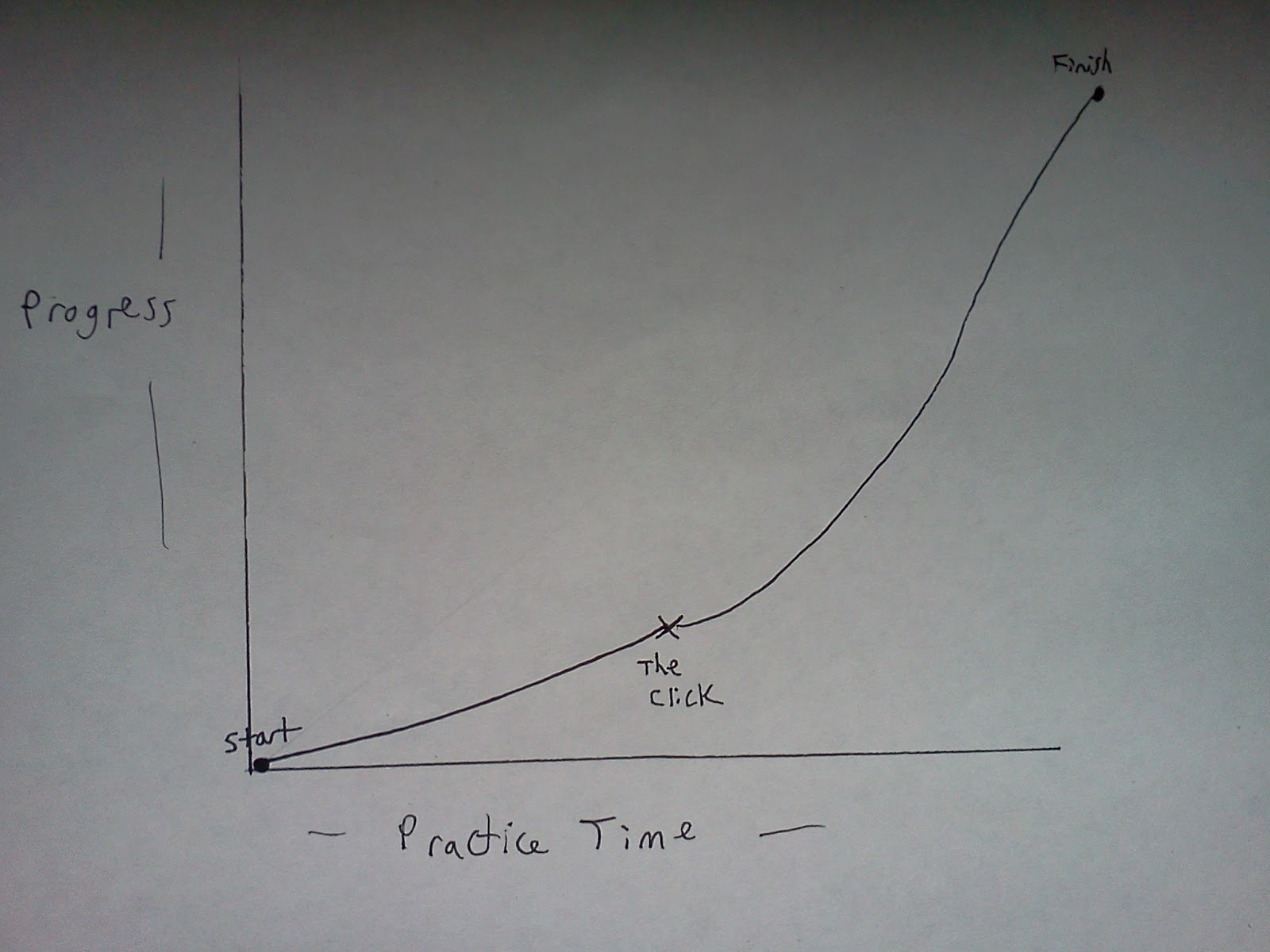
There's only one problem with it.  That straight line from start to finish is COMPLETELY WRONG.  If you go into your practice with expectation of smooth and steady progress, you are only going to achieve that if the new music is way too easy for you.  In other words, smooth and steady progress is actually an indication that you're playing the wrong music!

Here's the way correct practice actually looks:
Look what happens.  Nearly halfway through the time you expect to practice, you are barely making progress.  It looks hopeless.  It feels tedious.  Why?  It's because you are going v-e-r-y s-l-o-w.  You are being careful, making sure that every note and rhythm is learned correctly; making sure that at some point you can maintain a slow and steady beat; making sure that you have added correct pedaling, dynamics, articulation and whatever details the music asks for.  It's slow, but it's correct.

At some point, it finally feels good.  It feels easy.  I call this "The Click".  Look what happens after the click.  You take off!  Practice gets fun!  What you are now doing is taking the newly learned music and allowing it to feel easy and, if necessary, get faster.

To practice well, remember these 3 tips:
(1)  Don't mistake "The Click" for being the finish line.  Feeling comfortable with something is a beginning.  Ride it through to the end when you really, truly, thoroughly know it.  That's when music gets fun.  I know this has happened when a student can only play their pieces with careful thought and a very slow tempo.

(2) Don't rush to the 2nd half, beyond the click.  If going slow is difficult, going faster makes it worse - always!  Don't dive ahead into repeating music over and over without first making sure at a very slow tempo that it is completely correct.  I know this happens if the piece is confidently played, but with frequent mistakes.

(3) As a rule, work 2 to 4 measures at most with the above graph.  It takes 5 to 10 minutes if you're on the correct level (and if your note reading is par for your playing) to go from mystery to mastery in that time.  Trying a whole piece or even a large section will take a long, discouraging amount of time.

Always remember what correct practice looks like and what it doesn't.

Thursday, April 4, 2013

Practice Tip, Igudesman and Joo

Please note to all email subscribers, videos are not sent in emailed transcriptions of these blog posts.  I will try to always make it clear in the body of an article when a video is included, but you will need to follow the link within your emails to the actual blog article to view everything.  That includes this blog post.


Practice Tip - One Problem at a Time

If you've had a dozen lessons with me, then you almost certainly have heard me give you this very important principle to good practice.  Inevitably, you will attempt to learn something that seems overwhelming.  You have to address every obstacle in a piece of music in order to learn it completely, but you don't have to and shouldn't try to do it all at once.  That's probably obvious enough, but let's take it one step further:  don't even try to solve TWO things at once.  Limit it to one.

Sometimes the problem is as simple as getting from note # 1 to note # 2.  You may need to practice that slowly, then speed up.  Sometimes the rhythm is a problem.  Get off the keyboard and practice on a table.  No pitches to hear, so you need to focus on the rhythm.  Sometimes it's pedaling.  So pedal as you watch the music imagining you are playing without actually moving your hands.  We'll go over more ways than this, but the point is:  take care of just one problem at a time.  In a really tough passage, it may mean ignoring one problem while you work on another.  You'll do nothing but frustrate yourself trying to multi-task.

Meet Igudesman and Joo - Video and Concert Info

If you've ever been misled into thinking that classical music is boring, allow me to introduce you to the funniest classical comedy duo I've ever seen.  They are from England, and are Alexis Igudesman and Hyung-Ki Joo.  They are coming to Greensboro on Friday, April 12 at 8:00pm to perform with the Greensboro Symphony Orchestra to play their Big Nightmare Music show (as opposed to their two-person Little Nightmare Music show).  Here is a link for more info: http://www.greensborosymphony.org/season/2012-13/masterworks5.asp

Finally, I leave you with this video by Igudesman and Joo from their Little Nightmare Music show.  The next time you think you're having a tough piano lesson, compare it to this one and its pure madness!