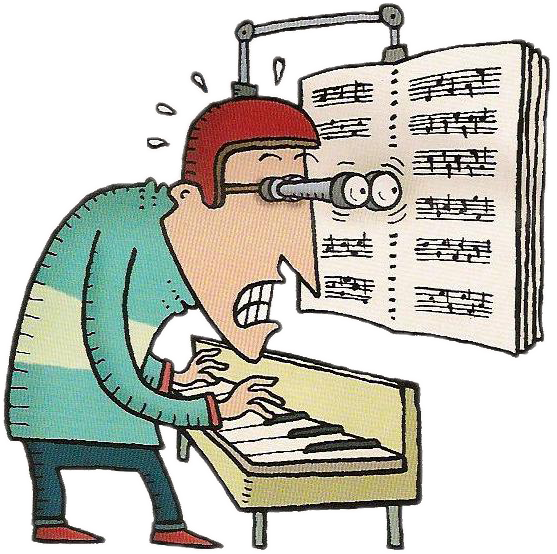
There are 2 points I made in the previous blog about sight-reading.
- You can aspire to be a pianist-for-hire without becoming a true virtuoso.
- Of all the things you need to improve to do well as a pianist-for-hire, there is nothing more important than sight-reading.
But how do you improve your sight-reading?
There are many approaches and techniques, enough so that I won't cover them here, but I'll give you some broad suggestions.
Learn your technique in your hands and on the staff.
So much of music is scales, chords, and arpeggios. Part of sight-reading well is to be able to not only recognize what you see, but actually be able to play it when you do. Again, there are two components. What does the technique look like within sheet music? And how do you play it?
Piano students more often than not underestimate the importance of technique and also the standards of good technique. For example, take the C major scale. Can you play it 1-octave hands separately? How about hands together? How about 2 octaves separately and together? 4 octaves? Contrary motion? In 3rds? In 6ths? How fast can you play each one? And that's just one scale.
Treat your technique with this recipe:
- Master a specific technique (i.e. 1-octave scale hands together) slowly with 100% correct fingering and 100% correct notes.
- Speed up until it's really fast.
- Make the technique harder (i.e. 2 octave scales)
- Repeat steps 1 through 3 over and over.
This can be a parallel development to everything else. You don't have to be in full mastery of every technique to be a good sight-reader, but the limit of your technique will limit the difficulty of what you can play in one attempt.
Improve your recognition of rhythms, notes, intervals, and chords
As I'm telling my students all the time, it's not enough to be able to look at a note on the staff, give it some thought, and then name the right note. Each note has to be INSTANTANEOUS in its recognition. But the truth is, while that's an ingredient to good sight-reading, it's only one of many. Much like reading this blog requires first knowing your alphabet, then recognizing words, the definitions of the words, the structure of a sentence, and groups of words creating a thought... your note recognition has to be combined with other elements.
- Rhythm: There are books just for rhythm that are progressive. I would find one with a CD or online demonstration/play-along and then ALWAYS try it without listening first, then listen to check how you did, then play again.
- Notes: The best way I know to learn is online games that involve beating the clock, such as musictheory.net/exercises/note. How many notes can you get right in a minute? Any slower than 30 per minute, and you're taking too long to think about it. See my recent blog post that gives a note-tutorial for musictheory.net
- Intervals: Recognition of 2nds, 3rds, 4ths, 5ths, etc is only helpful if you can do it without naming any of the notes. If I point to two notes on the staff and ask you to name the interval, and your response is to play the notes on the piano (example: C up to an F), and then say "a 4th!", you are not independently recognizing your intervals. Go to https://www.musictheory.net/exercises/interval. This is a great exercise because of the ability to increase the level of difficulty.

Let me know how you do with the Accidentals of doom!

If you are beginner, not only start with Level 1, but uncheck all of the intervals except the ones on this column. Then gradually add the rest of them.


Here is final setting. On the play mode, leave the setting at Harmonic, but at some point try Both. Finally, your game is ready, and looks like this.

- Chords: Chords are your more advanced vocabulary words. You want to learn root position chords, then inversions, then 7th chords and their inversions, then the more extended chords (especially if you're playing jazz, funk, or blues). I won't clutter this section with more screenshots, but the setup for https://www.musictheory.net/exercises/chord is very similar to that of the intervals, with 5 letters and everything. There is an Inversions button you can check on and off.
Raise your level of playing through experience
This is not a theory I can cite from other sources, but entirely my own observation. Your level of ability on any instrument is defined by the average level of all the music you've practiced. If you spend a lot of time on easy pieces that you can learn in a few days at most, then you're not pushing yourself. It's the brain-busters, the pieces that make you question yourself, the ones you have to take 1 and 2 measures at a time over and over really slowly that make you truly grow! You need to always have a project going that stretches you.
Get experience with sight-reading
If you decide to run a 5k race, you can go online and read all about strategy and correct form, and basically everything you need to know to run your best 5k time. However, none of it matters unless you actually practice running. The experience is where you improve, not the knowledge of it. All of the things mentioned here are tools. They equip you to do a good job, but you need to practice sight-reading and log in many, many hours of doing this very thing before you actually get good at sight-reading.
First, you need some materials. By that, I mean that you need music just for sight-reading. Ideally, it needs to be music that is comfortably but not excessively easier than your average playing level (see previous section on this blog). It's not to say that you couldn't go with something only moderately easier than your average that you would continue to practice and work up, but to know if you're improving your sight-reading, the goal is this: Find the hardest level of music (no matter how easy that is) that you can play on the first attempt with at least 80% accuracy. The goal is then to increase the difficulty level of the music you can play this well on the first attempt.
OPTIONS FOR COLLECTING SIGHT-READING MATERIALS: (1) You can always go to where sheet music is sold, and get method books for brands other than yours. Most of my students are on Faber's Piano Adventures. If you're not, then try that brand for sight-reading. Other common choices include Bastien, Alfred's, Hal Leonard, and The Music Tree. There are also books designed for Sight Reading (and includes this term in the title) where the exercises start very easy and get progressively more difficult as you go. (2) Shop used-book stores in the music section, or check Goodwill or other thrift stores. Many piano students don't often hold onto their student books after a while, and this is a good place to find easier music that you haven't previously practiced. (3) Seek out friends or family members who have taken lessons and see if you can at least borrow some of their music books.
The point is...practice for the sake of improving this skill many times a week. Grab something you've never played, and just play without stopping. Keep your eyes moving ahead, don't stop for mistakes, and see how you do. Very important: Before putting the music away, look at where you had any real trouble playing it well, and evaluate why it was hard. Did it involve notes, intervals, or chords that you found difficult to recognize quickly? Did you take your eyes off the page? Did you end up staring at the notes you were playing rather than looking ahead? Did the place in question involve technique (such as a scale) that you need to improve?
First, you need some materials. By that, I mean that you need music just for sight-reading. Ideally, it needs to be music that is comfortably but not excessively easier than your average playing level (see previous section on this blog). It's not to say that you couldn't go with something only moderately easier than your average that you would continue to practice and work up, but to know if you're improving your sight-reading, the goal is this: Find the hardest level of music (no matter how easy that is) that you can play on the first attempt with at least 80% accuracy. The goal is then to increase the difficulty level of the music you can play this well on the first attempt.
OPTIONS FOR COLLECTING SIGHT-READING MATERIALS: (1) You can always go to where sheet music is sold, and get method books for brands other than yours. Most of my students are on Faber's Piano Adventures. If you're not, then try that brand for sight-reading. Other common choices include Bastien, Alfred's, Hal Leonard, and The Music Tree. There are also books designed for Sight Reading (and includes this term in the title) where the exercises start very easy and get progressively more difficult as you go. (2) Shop used-book stores in the music section, or check Goodwill or other thrift stores. Many piano students don't often hold onto their student books after a while, and this is a good place to find easier music that you haven't previously practiced. (3) Seek out friends or family members who have taken lessons and see if you can at least borrow some of their music books.
The point is...practice for the sake of improving this skill many times a week. Grab something you've never played, and just play without stopping. Keep your eyes moving ahead, don't stop for mistakes, and see how you do. Very important: Before putting the music away, look at where you had any real trouble playing it well, and evaluate why it was hard. Did it involve notes, intervals, or chords that you found difficult to recognize quickly? Did you take your eyes off the page? Did you end up staring at the notes you were playing rather than looking ahead? Did the place in question involve technique (such as a scale) that you need to improve?
The under-rated skill-builder: playing from a hymnal!
Beginning students should probably ignore this section for now, but this is a great tip for intermediate students. This is also GREAT for jazz pianists. Buy a hymnal with traditional homophonic hymns. Homophonic means that the music looks mostly like this, where you have 4-notes per chord (most chords) and that each note is moving at the same rhythm (as opposed to polyphonic hymns where the soprano and alto might have different rhythms).
 One thing you'll notice about this that takes some getting used to is that, because hymns are written to be sung by a group of voices rather than to be played, you have to compensate that the tenor voice (top bass clef note) is often far apart from the bass voice (bottom bass clef note), often beyond the reach of your hand. Look at the last measure on the first line. The last note is an octave, but the two notes before that are difficult-to-unplayable stretches for the LH. However, in both cases, it is an easy reach to add the tenor notes to the bottom of the RH so that you are playing 3 right-hand notes vs 1 left-hand note. You'll also notice in places like the 5th note of the 2nd line that the tenor (top bass clef) and alto (bottom treble clef) notes are the same. Therefore, when you play it, you play the single note with one hand and ignore the other. These are the types of things that make playing hymns sneakily difficult. Nevertheless, they are invaluable and highly worth including in heavy doses of sight-reading for a few reasons.
First, in spite of the difficulty of learning how to play a hymn (singular), it doesn't take a lot of practice before it gets to be fairly easy to play hymns (plural). This is because there isn't much difference between the easiest and hardest hymns to play out of one hymnal. A few hours of practice and you'll lock in to HOW to play a hymn on the first attempt.
Second, (and jazz players, play attention!!), it is an unequaled way to gain experience in great-sounding chord voicings!! To refresh, chords are how notes are grouped together (CEG is a C major chord), but chord voicings are how they are organized between the hands (C-G in the LH, E-C in the RH) and how one chord moves to the other in a smooth way. Smooth voice leading in chords sounds great on any instrument, but it's actually imperative for groups of vocalists singing in harmony. Your inner voices (altos and tenors) would have a hard time for amateurs to sing their part if it was jumping all over the place, so they tend to have a lot of repeated notes and steps with only a few skips. Well, those same voice leadings are absolutely wonderful to use as reference when playing from a lead sheet. It doesn't take much practice to figure out how to convert them as 7th and 9th chords. And if you're not wanting to learn jazz from a lead-sheet, the voicings used in hymn harmonies are so often used in classical piano voicings for similar texture. Being proficient in hymn reading will have instant benefit on reading traditional piano music!
Finally, playing hymns gives you the ultimate practice in moving 4 parts of music at once. You cannot play hymns well if you are trying to move the top line, then the middle lines, then the bottom line chord-by-chord. You need to learn how to put your interval and note skills in combination and see how each chord moves as an entire group, NOT just one note at a time.
I haven't yet exhausted sight-reading as a subject, so I will probably revisit this some day, but I hope all of you who aren't absolute beginners will make sight-reading a regular priority in your practice!

First, in spite of the difficulty of learning how to play a hymn (singular), it doesn't take a lot of practice before it gets to be fairly easy to play hymns (plural). This is because there isn't much difference between the easiest and hardest hymns to play out of one hymnal. A few hours of practice and you'll lock in to HOW to play a hymn on the first attempt.
Second, (and jazz players, play attention!!), it is an unequaled way to gain experience in great-sounding chord voicings!! To refresh, chords are how notes are grouped together (CEG is a C major chord), but chord voicings are how they are organized between the hands (C-G in the LH, E-C in the RH) and how one chord moves to the other in a smooth way. Smooth voice leading in chords sounds great on any instrument, but it's actually imperative for groups of vocalists singing in harmony. Your inner voices (altos and tenors) would have a hard time for amateurs to sing their part if it was jumping all over the place, so they tend to have a lot of repeated notes and steps with only a few skips. Well, those same voice leadings are absolutely wonderful to use as reference when playing from a lead sheet. It doesn't take much practice to figure out how to convert them as 7th and 9th chords. And if you're not wanting to learn jazz from a lead-sheet, the voicings used in hymn harmonies are so often used in classical piano voicings for similar texture. Being proficient in hymn reading will have instant benefit on reading traditional piano music!
Finally, playing hymns gives you the ultimate practice in moving 4 parts of music at once. You cannot play hymns well if you are trying to move the top line, then the middle lines, then the bottom line chord-by-chord. You need to learn how to put your interval and note skills in combination and see how each chord moves as an entire group, NOT just one note at a time.
I haven't yet exhausted sight-reading as a subject, so I will probably revisit this some day, but I hope all of you who aren't absolute beginners will make sight-reading a regular priority in your practice!