WHY ARE YOU TAKING PIANO LESSONS?
That's more of an attention-grabbing question than I intended, but it's a question all students should ask of themselves at some point. This isn't a question with a right or wrong answer, but if your goal is to be good enough to compete in the Van Cliburn Competition (ongoing now, you can go to their website for radio/video footage), then you need to know what that takes as far as commitment. Here's a sample of some goals you could have as a pianist, and a general idea of what your preparation should look like.
1. Be acquainted with the piano. In other words, you know where the keys are. You might read some music, and you may even know a few pieces. You would be considered a beginner in terms of level. This can be accomplished with just a little daily practice (5-10 minutes) and a short-term period of lessons.
2. Play for small churches or include piano as a secondary/alternate instrument. If you're primarily a musician on another instrument, and just want to have a solid grasp of the piano as an instrument, or if you want to be able to play for a small church, then you need to work towards knowing your basics: scales, chords, arpeggios...and learn at least average sight-reading skills. Daily practice of 15-20 minutes average per day plus half-hour lessons will get you there.
3. Play as an ensemble player for rock, jazz or other non-classical group. This is a different type of focus. Reading music is nice, but you need to be great on your technique. You need to be as learned as you can with reading chords and incorporating them into music. You need to develop your ear training as much as you can. An ability to improvise a solo doesn't hurt. Half-hour to hour lessons are good, and you should be trying to average 30-45 minutes practice per day.
4. Be a well-rounded, intermediate pianist. Some people read "intermediate" and see this as less than good. Intermediate means you are playing solid, non-beginning music such as much of Mozart, some Chopin, some Beethoven...and sound good when you play. You're not playing flashy, virtuoso music, but there is plenty of intermediate music that sounds good to the majority of listeners. This needs a well-rounded music education and eventual commitment of 45 minutes to an hour practice. Don't worry about these numbers. You can work your way up to them.
5. Be a "gigging" professional musician. To be honest, even though I somewhat qualify for category # 6, this is truly my personal category. A gigging or working pianist can play for theatre shows like You're a Good Man, Charlie Brown, or large churches, or play for weddings/dinners/parties, and accompany dance studios. This takes a big commitment. Plan on years of lessons, eventually 1-hour long, learning as much music theory as possible, maximizing your ear training and sight reading skills, and fully mastering your technique. I recommend an average of 1-2 hours per day practice until you reach a high level. At this point, you can fall into a 30 minutes - 1 hour maintenance/slow progress.
6. Be a piano performance major at a conservatory like UNCSA. Because I teach in Winston-Salem, and because the University of North Carolina School of the Arts is so visible to the community, I sometimes get students who one day after taking a number of lessons decide that this is what they want to do. The only problem is that they've demonstrated the practice habits of one of the first 3 categories, probably not enough for category # 4 and certainly not for category # 5. This category is for serious pianists. The average performance major at UNCSA probably has averaged 3 to 4 hours of daily practice for years. You need to conquer everything. An hour lesson per week is minimal. To achieve this goal, you need to forget about most everything else. I don't mean school, but I mean other extracurricular activities. The people who make this goal are NOT well-rounded. They are specialists, very very good at this one skill. That's not to say you can't taper off and add some more to your life. The best organist I've ever met is now an avid long-distance bicyclist. That's now though. When I knew him in college, all he ever did was practice.
7. Top tier pianist. First, let me break this gently. Start young, and start aggressive. If you're 8 years old and not already practicing an hour or more per day and playing early intermediate repertoire, forget this goal. This is not your top 1% of pianists. This is your top 0.00001% of pianists. That's 30 Van Cliburn finalists measured against a roughly estimated 300 million pianists in the world. You need to devote your life to this single-minded purpose. Practice becomes your full-time job. 8 hours a day. You need to learn to master the most advanced repertoire that exists AND try to do it better than everyone else has. It's an intense goal that I could never recommend. You don't choose to do this goal. You are driven, compelled beyond reason to do this goal. In 13 years of teaching, I've had some talented students who have fit each of the first six categories. I've never had a student who came close to this. I never resembled anything close to this as a student myself. The only reason I put it here is for perspective. You need to know how your practice habits and goals stack up against the equivalent of the World Series quality for pianists.
Again, none of these 7 goals are better than the other. They are just various ways you can learn the instrument. Do you have to choose one now and keep it for life? No. However, you need to have a goal that suits where you are right now, and practice right now in such a way that you are working towards that end. Again this is only a sample, not comprehensive. Do you have a goal that doesn't fit the above categories?
Tuesday, May 28, 2013

Wednesday, May 22, 2013
Recital Wrap-up, Playing in Public, Summer Planning
RECITAL WRAP-UP
Congratulations to the 14 students who participated in the Spring Recital this past Sunday, May 19! I hope to see more new faces the next time we have one. Performance experience is much like real life. It's tempting to say, regardless of how you did this past weekend, that every time you perform will get easier and you'll do better each time. The reality is that there are too many factors. How nervous you are, how focused your concentration is, how well you've slept, how confident (without being overconfident) you are, and how well (not just how much) you've practiced will all determine how you do on any given day. This is why you can play perfectly one recital and not do so well the next. It's also why if you didn't play your best one recital, the next time you play might be really well.
Here are several things you can do to get better at performing in public.
1. Practice well. More practice is better than less practice, but that's not the same thing as practicing well. A big goal of practice should be to identify mistakes early and to work on what is causing the mistake, not just the mistake itself. Every mistake you've allowed yourself to make has the potential to show up when you're nervous. Fix the tendency to make them, and you'll play it right every time.
2. Memorize regularly. You have enough stress in life and even in lessons for me to actually assign memorization. To play well without music on a regular basis, you need to apply yourself to memorize something regularly. If this is difficult for you, try just 1 or 2 measures for a start. Later on, I'll likely write on proven methods of memorization, but for now try anyway you can. A good practical thing to memorize is if you have a page turn. Memorize several measures before and after the turn so you can be early or late turning the page. Take something you learned a while back and already know how to play well with the music and commit it to memory.
3. Watch your hands when you play. This is related to the above point. Every teacher I know says you should keep your eyes on the music, and not your hands when you play. This is correct...when you are FIRST learning the music. Sightreading well is impossible if you insist on looking at your hands more than the music. However, If your goal is to get off the music, then you need to get your eyes off the music. You may need to do this gradually.
4. Slow down and breathe. Breathing gets shallow when you get nervous. Take slow and deep breaths to clear your mind. Move slowly to and from the instrument. Set a tempo in your head before you play a note. This isn't the same suggestion as saying to play everything slowly. No, you should play everything up to tempo, but control your tempo.
5. Your audience supports you. Keep this in mind whenever you play. Who comes to hear you play? Not your enemies; not the people who can't stand you. It's people who care about you, and people who love music. An audience isn't a collection of judges. Instead, it is a group of silent cheerleaders. How can you possibly get nervous when you think of your listeners as a resource of support? I think the day I realized that was the day I stopped feeling fear in front of audiences. My nerves are now excitement. Remember this rule anytime you play for someone else.
SUMMER PLANNING
With school about to be out for a few months, this always brings up a few questions. Do you teach in the summer? Can I take time off and resume in the Fall? Is it better to continue taking lessons or take time off? Do I have to practice in the summer? How can I practice when I'm at camp/the beach, etc?
Do you teach in the summer? Yes. I teach year-round. Count on no lessons for July 4, but there are no other days I plan to miss as of this moment.
Can I take time off and resume in the Fall? Yes. My policy is that you must pay a two-week minimum whether you attend or not to maintain your spot when you return. If you choose to take time off without payment, then you would need to find a new vacant time when you return.
Is it better to continue taking lessons or take time off? If you are progressing at all, it's always better to continue. It's virtually a law of nature that the more time you take off from lessons, the more time will be needed for review just to get back to where you are. However, if lessons and/or practice time have been frustrating, you won't be hindering progress with a break. It may be just what you need.
Do I have to practice in the summer? Let's answer this as if you're at home and have much more free time. Why wouldn't you practice? In fact, why not practice more? The number one reason I hear from students for not having practiced well in a particular week is that they had too much homework. This is not a problem in the summer. In fact, this is an OPPORTUNITY! Practice like you never have before!
How can I practice when I'm at camp/the beach, etc? If you're on vacation, I'm not going to suggest that you should practice hard, but it's possible and not unreasonable to take 10-15 minutes each day and do some mental practice. You can practice scale fingerings, for example. You can take a piece or two with the music, and play it on a table or desk as if you were playing on the keyboard. This has been shown to be roughly 80% as effective as playing on a keyboard or piano.
Congratulations to the 14 students who participated in the Spring Recital this past Sunday, May 19! I hope to see more new faces the next time we have one. Performance experience is much like real life. It's tempting to say, regardless of how you did this past weekend, that every time you perform will get easier and you'll do better each time. The reality is that there are too many factors. How nervous you are, how focused your concentration is, how well you've slept, how confident (without being overconfident) you are, and how well (not just how much) you've practiced will all determine how you do on any given day. This is why you can play perfectly one recital and not do so well the next. It's also why if you didn't play your best one recital, the next time you play might be really well.
Here are several things you can do to get better at performing in public.
1. Practice well. More practice is better than less practice, but that's not the same thing as practicing well. A big goal of practice should be to identify mistakes early and to work on what is causing the mistake, not just the mistake itself. Every mistake you've allowed yourself to make has the potential to show up when you're nervous. Fix the tendency to make them, and you'll play it right every time.
2. Memorize regularly. You have enough stress in life and even in lessons for me to actually assign memorization. To play well without music on a regular basis, you need to apply yourself to memorize something regularly. If this is difficult for you, try just 1 or 2 measures for a start. Later on, I'll likely write on proven methods of memorization, but for now try anyway you can. A good practical thing to memorize is if you have a page turn. Memorize several measures before and after the turn so you can be early or late turning the page. Take something you learned a while back and already know how to play well with the music and commit it to memory.
3. Watch your hands when you play. This is related to the above point. Every teacher I know says you should keep your eyes on the music, and not your hands when you play. This is correct...when you are FIRST learning the music. Sightreading well is impossible if you insist on looking at your hands more than the music. However, If your goal is to get off the music, then you need to get your eyes off the music. You may need to do this gradually.
4. Slow down and breathe. Breathing gets shallow when you get nervous. Take slow and deep breaths to clear your mind. Move slowly to and from the instrument. Set a tempo in your head before you play a note. This isn't the same suggestion as saying to play everything slowly. No, you should play everything up to tempo, but control your tempo.
5. Your audience supports you. Keep this in mind whenever you play. Who comes to hear you play? Not your enemies; not the people who can't stand you. It's people who care about you, and people who love music. An audience isn't a collection of judges. Instead, it is a group of silent cheerleaders. How can you possibly get nervous when you think of your listeners as a resource of support? I think the day I realized that was the day I stopped feeling fear in front of audiences. My nerves are now excitement. Remember this rule anytime you play for someone else.
SUMMER PLANNING
With school about to be out for a few months, this always brings up a few questions. Do you teach in the summer? Can I take time off and resume in the Fall? Is it better to continue taking lessons or take time off? Do I have to practice in the summer? How can I practice when I'm at camp/the beach, etc?
Do you teach in the summer? Yes. I teach year-round. Count on no lessons for July 4, but there are no other days I plan to miss as of this moment.
Can I take time off and resume in the Fall? Yes. My policy is that you must pay a two-week minimum whether you attend or not to maintain your spot when you return. If you choose to take time off without payment, then you would need to find a new vacant time when you return.
Is it better to continue taking lessons or take time off? If you are progressing at all, it's always better to continue. It's virtually a law of nature that the more time you take off from lessons, the more time will be needed for review just to get back to where you are. However, if lessons and/or practice time have been frustrating, you won't be hindering progress with a break. It may be just what you need.
Do I have to practice in the summer? Let's answer this as if you're at home and have much more free time. Why wouldn't you practice? In fact, why not practice more? The number one reason I hear from students for not having practiced well in a particular week is that they had too much homework. This is not a problem in the summer. In fact, this is an OPPORTUNITY! Practice like you never have before!
How can I practice when I'm at camp/the beach, etc? If you're on vacation, I'm not going to suggest that you should practice hard, but it's possible and not unreasonable to take 10-15 minutes each day and do some mental practice. You can practice scale fingerings, for example. You can take a piece or two with the music, and play it on a table or desk as if you were playing on the keyboard. This has been shown to be roughly 80% as effective as playing on a keyboard or piano.
Saturday, May 18, 2013
Recital Basics
Tomorrow is the date of the Spring Recital at Pfafftown Baptist Church, 4336 Transou Rd, Pfafftown, NC at 3:00pm.
Here are some things to remember:
Performers: Early means on time, "on time" means late
Good performers not only don't show up late; They don't even risk the chance of it. Aim for arriving 15 minutes early. If you're running late, you still have a safety window. However, if you arrive on time, you can relax in your surroundings and get used to being there before the recital begins.
Remember Stage Presence
Don't sit down before you take a bow. Don't leave the piano before you take a bow. In the case of the latter, it doesn't matter how you think you did. Sometimes we don't perform as well as expected, and in our self-disgust we forget our etiquette. Always remember your stage presence.
Don't try for better than ever, just as good as normal
The best you've ever played your piece(s) ever is as good as you can expect in a performance. Don't try for the miraculous flawless all-star performance. You'll feel deflated after the first mistake. The tension will cause more mistakes to come. Relax. Trust your preparation, and remember that practice time is over once you play. You're not to even consider monitoring your mistakes or trying to improve it. You have all the way until you leave the house tomorrow to improve and prepare. That's all you can do at that point. Trust it, and show it off.
Give yourself room to fail
With all that said above, you will probably make a mistake. You might, just might play a note-perfect piece with your best ever playing, but that's not super common. So many things have to go right for a flawless performance. If you expect something wrong might happen, you won't be caught off guard. Remember, you might not mess up, but give yourself permission to do so. Public performance is just as much about selling your wrong notes as playing the right ones. You'll know your mistakes far better than nearly everyone who is listening.
What to Wear
There is no required dress code, but a recital is considered at least a semi-formal event. Suggested dress is button-up shirt, slacks and dressier shoes for guys. Coat and/or tie are optional. Girls should consider a dress or a dressier casual look. If you don't own anything like this, wear the best you have.
Good luck to everyone, please remember to review the Recital Etiquette before tomorrow. Have fun, and I will see you soon!
Here are some things to remember:
Performers: Early means on time, "on time" means late
Good performers not only don't show up late; They don't even risk the chance of it. Aim for arriving 15 minutes early. If you're running late, you still have a safety window. However, if you arrive on time, you can relax in your surroundings and get used to being there before the recital begins.
Remember Stage Presence
Don't sit down before you take a bow. Don't leave the piano before you take a bow. In the case of the latter, it doesn't matter how you think you did. Sometimes we don't perform as well as expected, and in our self-disgust we forget our etiquette. Always remember your stage presence.
Don't try for better than ever, just as good as normal
The best you've ever played your piece(s) ever is as good as you can expect in a performance. Don't try for the miraculous flawless all-star performance. You'll feel deflated after the first mistake. The tension will cause more mistakes to come. Relax. Trust your preparation, and remember that practice time is over once you play. You're not to even consider monitoring your mistakes or trying to improve it. You have all the way until you leave the house tomorrow to improve and prepare. That's all you can do at that point. Trust it, and show it off.
Give yourself room to fail
With all that said above, you will probably make a mistake. You might, just might play a note-perfect piece with your best ever playing, but that's not super common. So many things have to go right for a flawless performance. If you expect something wrong might happen, you won't be caught off guard. Remember, you might not mess up, but give yourself permission to do so. Public performance is just as much about selling your wrong notes as playing the right ones. You'll know your mistakes far better than nearly everyone who is listening.
What to Wear
There is no required dress code, but a recital is considered at least a semi-formal event. Suggested dress is button-up shirt, slacks and dressier shoes for guys. Coat and/or tie are optional. Girls should consider a dress or a dressier casual look. If you don't own anything like this, wear the best you have.
Good luck to everyone, please remember to review the Recital Etiquette before tomorrow. Have fun, and I will see you soon!
Wednesday, May 8, 2013
Upcoming Recital Details
Time and Location
The Spring Recital will be at 3:00pm, on Sunday May 19, at Pfafftown Baptist Church; 4336 Transou Rd, Pfafftown, NC. If participating, you should arrive 15 minutes early. If you wish to arrive earlier, doors will open about 2:15.

Performer Traditions and Etiquette
Everybody performing in the Spring Recital this year is playing a solo and, according to the rules of tradition, should play from memory. Music will be permitted to review while at your seat, but please leave it behind when you walk up to play. Take your time in walking to and from the piano. Don't rush. Remember to bow before AND after you play. If you play two pieces, you should not bow in between pieces. Don't forget to adjust the bench. Don't settle for your one-time performance if you know it is too close or far from the piano to do your best. Performers, be sure to go to the restroom before the recital begins. Students have missed their turn in the past for underestimating how soon their turn would arrive while making a "quick trip". Family members should sit in pews in a way that does not make it difficult for the student to get out of the seat and up to the piano.
Audience Etiquette
The recital is a maximum of 40 minutes, probably less. The primary rule I would ask is that you arrive on time and stay through the end if at all possible. It is appropriate to applaud each performer as he or she walks up to the piano, and after they have played all their selections. It is not appropriate to clap after each selection when a student has more than one piece. Please allow silence after the first of multiple pieces. Avoid flash photography while a piece is being played. This can distract students who are already nervous. Video taping is permitted provided it doesn't obstruct anyone's view. If you share videos afterward on YouTube or another public forum, please be mindful of copyright laws. Only a few of the pieces being played are public domain. A good solution is to only post things privately where a link is required to view the video.
NEW - Seating Requirement
As the sanctuary will seat about triple what I'm expecting for the recital, I want to address an issue that has been a problem for me in past performances as a teacher, and that is sitting so close to the piano that the student doesn't even have to walk up to perform; They just stand up and they're already at the piano. "The walk" is as much apart of the recital experience as everything else. So I am more specific this year about where I want students to sit. Though I'm very close to going to a "all students sit together" policy, I want to try to keep students with families during these events.

This photo is from a Christmas service at the church several years ago, but will give you an idea of the sanctuary's layout when viewing the piano. The piano is on the left. The FIRST TWO PEWS on that side are off-limits to students. Family members, especially ones with hand-held video cameras are permitted to sit there, but Do not sit there if you are performing. In addition, please note this center aisle in the middle of the photo. It represents two of four ways to leave your seat and go to the piano. Another way is to sit on the right pews and exit the far right side (off the picture). This is okay. Another option is to sit on the far left and walk up the aisle closest the left windows (also off the picture). This is NOT okay. I will angle the piano in such a way that the audience on the right can still get a good view, but I appreciate everyone following these guidelines this year. There are plenty of seats, and again this limitation is only for the students. Family members can sit anywhere.
Monday, May 6, 2013
Two Most Important Visuals for Musicians
For years, I've mentioned in lessons that there are two things a musician can know well and really increase their overall musicianship level. The two items are the Rhythm Pyramid and the Circle of Fifths.
The Rhythm Pyramid
 What's most important about this image is what it doesn't tell you, and that is how many beats each item gets. If you haven't reached this point in your lessons yet, you will; Quarter notes don't always get 1 beat. Sometimes they get 2. Sometimes they only get 1/2 beat. The bottom number of a time signature tells you what the beat is. If it's a 4, then a quarter note is 1 beat. If it's something else, then you have to change the values of all these notes. But here's what stays the same: THIS PICTURE.
A whole note (at the top) is equal to any one of the rows below it (2 half notes, 4 quarters, etc). Then notice the diagram lines to see what fits into a half note. Look at what fits into a quarter note. In other words. the number values may change, but the ratios stay the same...always. It's something you can count on, and is the ultimate way of understanding rhythm.
The Circle of Fifths
 I can only graze the surface of what the Circle of Fifths shows you, because it is an amazing tool. I've discovered more and more intricacies to it since I started teaching. But here's what you need to know.
Once you've begun to study key signatures, you'll learn that you can have up to 7 sharps or 7 flats in a piece. The Circle of Fifths is what it says it is: a circular diagram showing the letters in music going up (clockwise) or down (counterclockwise) by a perfect fifth (7 half steps). This arrangement shows you many things but here are the most important:
The Rhythm Pyramid
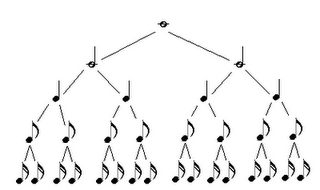
A whole note (at the top) is equal to any one of the rows below it (2 half notes, 4 quarters, etc). Then notice the diagram lines to see what fits into a half note. Look at what fits into a quarter note. In other words. the number values may change, but the ratios stay the same...always. It's something you can count on, and is the ultimate way of understanding rhythm.
The Circle of Fifths
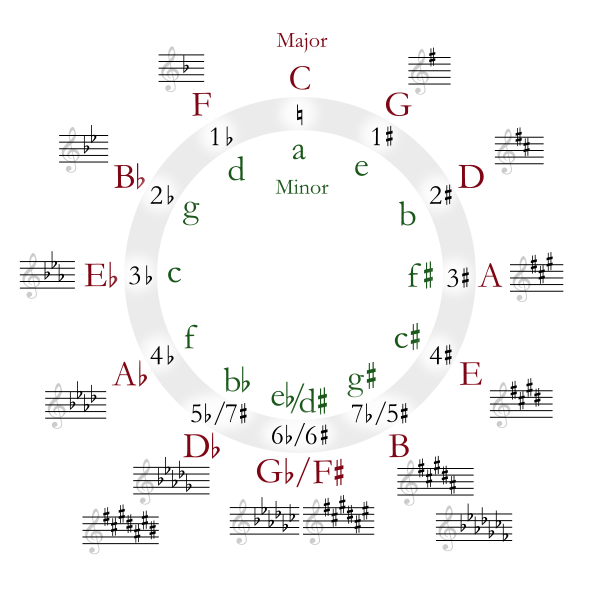
Once you've begun to study key signatures, you'll learn that you can have up to 7 sharps or 7 flats in a piece. The Circle of Fifths is what it says it is: a circular diagram showing the letters in music going up (clockwise) or down (counterclockwise) by a perfect fifth (7 half steps). This arrangement shows you many things but here are the most important:
- The order by which keys are sharp or flat. Start at the top and go to the right. You go from 0 sharps to 7 sharps, Go to the left from the top, and you go from 0 flats to 7 flats.
- The order of sharps and flats. Sharps and flats occur in a traditional order. If you have ANY sharps in the key signature, you can count on it being an F#. If you have a flat, it will include B-flat. Here's what's going on. Go to the top of the circle where you'd put "11" on a clock. That's the letter F. Start there and read the 1st 7 letters clockwise: F-C-G-D-A-E-B. That is your order of sharps in a key signature. Now go in reverse: B-E-A-D-G-C-F. That is the order of flats.
If any of the above seems complicated, it's only because we've either not gone over it much in your lessons or because they are both very versatile. It's not a tool for teaching from scratch, but it illuminates what you're learning in your lessons. If you can memorize the above images (and keep in mind that both have many variations out there), you'll know so much about music just from this.
Thursday, April 4, 2013
Practice Tip, Igudesman and Joo
Please note to all email subscribers, videos are not sent in emailed transcriptions of these blog posts. I will try to always make it clear in the body of an article when a video is included, but you will need to follow the link within your emails to the actual blog article to view everything. That includes this blog post.
Practice Tip - One Problem at a Time
If you've had a dozen lessons with me, then you almost certainly have heard me give you this very important principle to good practice. Inevitably, you will attempt to learn something that seems overwhelming. You have to address every obstacle in a piece of music in order to learn it completely, but you don't have to and shouldn't try to do it all at once. That's probably obvious enough, but let's take it one step further: don't even try to solve TWO things at once. Limit it to one.
Sometimes the problem is as simple as getting from note # 1 to note # 2. You may need to practice that slowly, then speed up. Sometimes the rhythm is a problem. Get off the keyboard and practice on a table. No pitches to hear, so you need to focus on the rhythm. Sometimes it's pedaling. So pedal as you watch the music imagining you are playing without actually moving your hands. We'll go over more ways than this, but the point is: take care of just one problem at a time. In a really tough passage, it may mean ignoring one problem while you work on another. You'll do nothing but frustrate yourself trying to multi-task.
Meet Igudesman and Joo - Video and Concert Info
If you've ever been misled into thinking that classical music is boring, allow me to introduce you to the funniest classical comedy duo I've ever seen. They are from England, and are Alexis Igudesman and Hyung-Ki Joo. They are coming to Greensboro on Friday, April 12 at 8:00pm to perform with the Greensboro Symphony Orchestra to play their Big Nightmare Music show (as opposed to their two-person Little Nightmare Music show). Here is a link for more info: http://www.greensborosymphony.org/season/2012-13/masterworks5.asp
Finally, I leave you with this video by Igudesman and Joo from their Little Nightmare Music show. The next time you think you're having a tough piano lesson, compare it to this one and its pure madness!
Tuesday, April 2, 2013
Is a half-hour lesson enough?
Three reasons for upgrading to a one hour lesson per week
By default, I teach a half-hour lesson per student each week. It's less expensive and tends to be the right amount of time needed to go over the material that the average student practices in one week. A few of you would benefit by upgrading to an hour each week. Here are three signs to check and see if it's right for you.
1. Half-hour lessons feel rushed. If you are practicing more music than we have time to properly go over in a 30 minute lesson, then you should consider expanding to a 60 minute lesson. One of the downsides to practicing and progressing a lot is that you may be outpacing what we can properly review during the lesson. An hour makes it so much easier for the ambitious or advancing student to get proper coaching.
2. You desire an additional focus. Some piano students may also want to study French horn. They may want more focus on theory. They may want to learn both classical AND jazz/pop styles of playing. They may want to additionally learn composing. If you want to learn piano AND something else, then you need an hour.
3. It is within your budget. Choose reason number 1 OR number 2, but then add this third reason. I do offer a discount per half-hour when you expand to an hour by a difference of $20 per month, but this is still more total money for your music education than a half-hour lesson. If you or your child is single-focused or having only a small time to practice, I do not recommend adding money for more time. It's very difficult to fill an hour's time with material in those situations, and your money is not as efficiently being used. If you fit one of the first two choices, you should look at your budget and see if you can fit it in. Hour lessons aren't always immediately available to schedule, but by putting in a request, I can arrange the time as soon as possible for you to get this in. If you are unsure whether you are the type of student who would benefit, please email me, and I will give you my honest opinion. If you are a prospect and unsure about whether an hour lesson would be more beneficial than a half-hour, then I always suggest starting with a half-hour and seeing if it feels like enough, and then expand to an hour as needed.
By default, I teach a half-hour lesson per student each week. It's less expensive and tends to be the right amount of time needed to go over the material that the average student practices in one week. A few of you would benefit by upgrading to an hour each week. Here are three signs to check and see if it's right for you.
1. Half-hour lessons feel rushed. If you are practicing more music than we have time to properly go over in a 30 minute lesson, then you should consider expanding to a 60 minute lesson. One of the downsides to practicing and progressing a lot is that you may be outpacing what we can properly review during the lesson. An hour makes it so much easier for the ambitious or advancing student to get proper coaching.
2. You desire an additional focus. Some piano students may also want to study French horn. They may want more focus on theory. They may want to learn both classical AND jazz/pop styles of playing. They may want to additionally learn composing. If you want to learn piano AND something else, then you need an hour.
3. It is within your budget. Choose reason number 1 OR number 2, but then add this third reason. I do offer a discount per half-hour when you expand to an hour by a difference of $20 per month, but this is still more total money for your music education than a half-hour lesson. If you or your child is single-focused or having only a small time to practice, I do not recommend adding money for more time. It's very difficult to fill an hour's time with material in those situations, and your money is not as efficiently being used. If you fit one of the first two choices, you should look at your budget and see if you can fit it in. Hour lessons aren't always immediately available to schedule, but by putting in a request, I can arrange the time as soon as possible for you to get this in. If you are unsure whether you are the type of student who would benefit, please email me, and I will give you my honest opinion. If you are a prospect and unsure about whether an hour lesson would be more beneficial than a half-hour, then I always suggest starting with a half-hour and seeing if it feels like enough, and then expand to an hour as needed.
Subscribe to:
Posts (Atom)